I had not expected all this to drag on for months. However whether it takes months or years, once I have got the bit between my teeth I am not swift to let go. Unfortunately this determination is sometimes required to get effective action taken by those whose job it is to serve the public.
The BMW assailant
First, the case of the BMW driver who assaulted me and a colleague on 12th December (more here). I have received, and accepted, profuse apologies from Thames Valley Police delivered in person by a senior officer visiting my home. (Interestingly the Inspector concerned suggested I might consider using a helmet camera!). The apology is for deciding on a police caution without first seeking my views or awaiting details of my injuries. This admitted failing has been dealt with by providing managerial advice to the civilian officer who handled the case and the custody sergeant who approved the caution. I only wish that half the effort into investigating and pursuing police staff who have made a mistake, went into the investigation and pursuit of the assailant. It is of course only right that complaints against the police are taken seriously, but I am left with an uncomfortable feeling that the police involved have come off worse than the man who actually attacked me.
This feeling is reinforced by the fact that, rightly, I was given the identity of the police officers involved as soon as I asked; whereas the identity of my assailant has just this moment, many weeks after my request, been revealed to me.
When the apology was given the senior police officer insisted that Home Office Guidance required the police to issue a caution rather than to charge the offender. I have to say we disagreed about whether the offence was to be regarded as plain assault or as assault occasioning actual bodily harm, and further disagreed as to whether aggravating (unprovoked attack or vulnerable victim) or mitigating (heat of the moment) features were present. Nonetheless it is clear that the police genuinely believe themselves to be required to deal with an assault of this type by a caution. That being so, it is necessary to move on to criticise the content of the Home Office Guidance.
I previously wrote to the Home Secretary about this guidance. At first my letter was forwarded to the Ministry of Justice but I wrote again asking that it be placed before the Home Secretary. This was not done, instead I got a letter from a Home Office official misconstruing my point as being about police operational matters.
I have therefore now taken this up with my own MP as follows:
"Dear Mr Afriyie,
Police Cautions for Violent Assaults
I am very concerned about the guidance that has been given to Police Forces by the Home Office (Home Office Circular 30/2005 addressed to Chief Constables and copied to Crown Prosecutors) under the previous Government.
I have been assured by Thames Valley police that the ‘Gravity Factors Matrix’ contained within this guidance required them to deal with an offender who assaulted me on the street last December, causing me actual bodily harm and potentially risking far more serious injury, with a caution. As it happens, I was riding my bicycle (an activity that I know both you and the current Government encourage) when this occurred and was therefore particularly vulnerable to this kind of violent assault.
I will say no more about the particular circumstances of that offence as I am not raising with you the police action taken in accordance with Home Office Guidance but with the Guidance itself. This guidance needs to be reviewed.
Parliament lays down laws for the protection of society and as a citizen I consider it my right to expect the protection of the law. I question whether it can really be acceptable that the police are required by Home Office Guidance (apparently agreed with senior police officers and the CPS but by nobody democratically accountable) not to charge the perpetrator of a violent offence and bring him before the Courts.
I have tried to raise this directly with your colleague, Mrs Theresa May, (in whose constituency the assault coincidently occurred) but received only a dismissive response from a Home Office Official misinterpreting my letter as a complaint about operational police matters.
I would be most grateful if you could raise this policy issue on my behalf with Mrs May.
Yours sincerely,
Martin Porter"
The threat to kill
Second, the incident on 4th November (more here). I got excited in December when told that the investigation into this was to be reopened and self-imposed a news blackout. Two months on the police resubmitted the evidence to the CPS but (still) without taking any steps to identify the driver from his registration number. The CPS asked the police to undertake some minimal investigation (i.e who was the driver at the time?). The last I heard from the police was that they were 'in the process of tracking down the previous owner of the vehicle'.
I am not prepared to hold silence indefinitely and have now reopened the video clips for viewing on youtube (here, and here) and a short extract was shown on prime time television last Thursday, along with my statements of (what should be) obvious fault on the part of some motorists and my optimistic hope that video evidence could corroborate a cyclist's account of poor motoring. Some people maintain that cyclists with cameras are 'looking for trouble' but I do not see how this can possibly be said about any of the cyclists whose film appeared on 'The One Show'.
Most of what I said hit the cutting room floor and I suspect this item was considerably shortened because between the time of filming and broadcast BBC Breakfast ran a similar item. It is, I feel, a pity that what was left was the journalistic hyperbole of a 'war between cyclists and motorists'. It was left to the guest, Griff Rhys Jones, to make the rather obvious point that what is needed is peace on the roads. He is not the first to think of that; Roadpeace have been urging it for decades. The peace, though, needs to be not merely wished but also enforced.
Monday, 21 February 2011


Monday, 7 February 2011
Imperial Winter Series Race 11: Saturday 5th February
A mild 12ºC but with a very strong and blustery southwest wind which meant that I was bound to struggle. My new Ribble winter training bike was introduced to racing today. I would like to think that I had learned something from the last time I was out in the strong wind. Possibly I did do a bit better for a while, keeping to the middle of the pack and avoiding the hazard area. However, there were some strong riders making a sustained effort to break away and the pace was relentlessly high while that was going on. After 20 minutes I was left hoping that the split would happen as I was on my limit and drifting to the back Once at the back at around 30 minutes in, I was holding the penultimate wheel straight into the wind but the inevitable gap opened up and we were sunk. We were by no means the first to be dropped and I believe that, frustratingly, the group of three got clear off the front just after I came off the back. With a bit of help from other dropped riders and from the 4th cat race, I avoided being lapped until one to go.
For me it was 24.7 miles in 1hr 04m 50s. An average speed of 22.9 and a max of 29.3 mph.
I am away next week so this was my last Winter Series race for this year. It has, as always, been huge fun and provides some intense riding in the off season which I am just not motivated to find on the road or on a turbo. A huge thank you to the Collins family and Imperial Racing for promoting the series.
Wednesday, 2 February 2011
Cycling Infrastructure Again
Responding to Dr Julian Huppert MP, the Minister of State for Transport Theresa Villiers stated in Parliament that, "Manual for Streets 2" was recently published after a lot of input from different stakeholders. My understanding is that those documents are heavily used by local authorities in their work on our roads and streets. The uptake of those documents is more extensive than my hon. Friend has been led to believe."
The trouble is that Dr Huppert is right and Ms Villiers is wrong; most cycling infrastructure in this country is useless or worse. The manual for streets does not descend to detail on the design requirements for cycling infrastructure but this is to be found in the sister document, Cycle Infrastructure Design
Take this example, on my commute home from work

The A315 west of Hounslow on my way home. The lane on the left is perhaps 0.5metres wide
The Department for Transport's own design criteria provide that:
"7.4 Cycle lane widths 7.4.1 A cycle lane offers cyclists some separation from motor traffic. Under the National Cycle Training Standards, cyclists are trained to ride in a safe position in the carriageway which is usually at least 1 metre from the kerb edge to avoid gulley grates and debris, and to ensure that they are within the sightlines of drivers waiting at side roads.
7.4.2 Cycle lanes should be 2 metres wide on busy roads, or where traffic is travelling in excess of 40 mph. A minimum width of 1.5 metres may be generally acceptable on roads with a 30 mph limit. For cycle feeder lanes to advanced stop line arrangements, a minimum width of 1.2m may be acceptable. Cycle lanes less than 1.2 metres wide cannot easily accommodate tricycles or childcarrying cycle trailers wholly within the lane.
7.4.3 Cyclists can overtake each other within a 2metre wide lane and easily remain within it when looking back to check for traffic, or when avoiding kerbside drainage grates, etc. Drivers do not always realise that cyclists need to move away from the kerb to avoid surface hazards and may expect cyclists to stay in lane regardless of its width. A narrow cycle lane may therefore give motorists (misplaced) confidence to provide less clearance while overtaking than they would in the absence of a cycle lane."
That last part is too true
What should cyclists do faced with this hopeless provision? Ideally, we should ignore the lane and ride as though it was not there, but that runs a greater than usual risk of attracting aggression from uncomprehending motorists. I tend to follow John Franklin's suggestion of straddling the line. This is hardly ideal and Government complacancy about the design of our streets clearly needs to be dispelled. It would be much safer if the cycle lane were just removed.
The trouble is that Dr Huppert is right and Ms Villiers is wrong; most cycling infrastructure in this country is useless or worse. The manual for streets does not descend to detail on the design requirements for cycling infrastructure but this is to be found in the sister document, Cycle Infrastructure Design
Take this example, on my commute home from work

7.4.2 Cycle lanes should be 2 metres wide on busy roads, or where traffic is travelling in excess of 40 mph. A minimum width of 1.5 metres may be generally acceptable on roads with a 30 mph limit. For cycle feeder lanes to advanced stop line arrangements, a minimum width of 1.2m may be acceptable. Cycle lanes less than 1.2 metres wide cannot easily accommodate tricycles or childcarrying cycle trailers wholly within the lane.
7.4.3 Cyclists can overtake each other within a 2metre wide lane and easily remain within it when looking back to check for traffic, or when avoiding kerbside drainage grates, etc. Drivers do not always realise that cyclists need to move away from the kerb to avoid surface hazards and may expect cyclists to stay in lane regardless of its width. A narrow cycle lane may therefore give motorists (misplaced) confidence to provide less clearance while overtaking than they would in the absence of a cycle lane."
That last part is too true
What should cyclists do faced with this hopeless provision? Ideally, we should ignore the lane and ride as though it was not there, but that runs a greater than usual risk of attracting aggression from uncomprehending motorists. I tend to follow John Franklin's suggestion of straddling the line. This is hardly ideal and Government complacancy about the design of our streets clearly needs to be dispelled. It would be much safer if the cycle lane were just removed.
Saturday, 29 January 2011
Imperial Winter Series Race 10; Saturday 29th January

Photo courtesy of LondonCycleSport
A distinctly cool 2ºC with a fresh northerly wind to add a wind-chill that left my hands numb until the race had been on long enough to get the circulation going. A few spirited attacks off the front but (as far as I could see) again nothing stuck. We passed the 4th cats twice, once whilst they were racing and again as they were warming down and not yet cleared the circuit. Every time the pace picked up to haul someone in I found my self at (but thankfully never off) the back. The sprint straight into the wind was interrupted by a sortie onto the grass on the right so I just kept left to roll in at the back of the bunch.
24.9m in 1h:01m:20s. Average speed 24.4mph. Top speed 32.9 mph.
Photo courtesy of Lucy Collin
Thursday, 27 January 2011
CTC Cycle Magazine Article Clarification and Update
There are, I fear, inaccuracies in the latest CTC magazine 'Road Safety Watch' about my experiences in two quite separate incidents.
1. On 4th November 2010, I was threatened by a motorist. I had helmet cam footage and took it to the police. Initially the Police and CPS decided to take no action. I complained, did get a response, and an investigation is now taking place. I had a letter from a Senior Crown Prosecutor yesterday telling me that the police had been asked to make further enquiries. I do not know, but I interpret this as suggesting that the police have still not interviewed the suspect. I await further developments.
2. On 12th December 2010, a motorist jumped out of his car and assaulted me and a club-mate. I did not have my camera but there was overwhelming evidence including that of an independant witness. The motorist was traced by the police, interviewed, accepted his guilt and was given a police caution. I queried the decision to caution the offender with the Chief Constable of Thames Valley Police. I received an e mail yesterday apologising for delay and saying that this would be investigated by an Inspector. I have asked Thames Valley Police for the name and address of my assailant but have been told that this request will not be considered until I put it into a letter.
I have separately written to the Home Secretary but have still not received any substantive response. I will now have to take this up with my own MP.
1. On 4th November 2010, I was threatened by a motorist. I had helmet cam footage and took it to the police. Initially the Police and CPS decided to take no action. I complained, did get a response, and an investigation is now taking place. I had a letter from a Senior Crown Prosecutor yesterday telling me that the police had been asked to make further enquiries. I do not know, but I interpret this as suggesting that the police have still not interviewed the suspect. I await further developments.
2. On 12th December 2010, a motorist jumped out of his car and assaulted me and a club-mate. I did not have my camera but there was overwhelming evidence including that of an independant witness. The motorist was traced by the police, interviewed, accepted his guilt and was given a police caution. I queried the decision to caution the offender with the Chief Constable of Thames Valley Police. I received an e mail yesterday apologising for delay and saying that this would be investigated by an Inspector. I have asked Thames Valley Police for the name and address of my assailant but have been told that this request will not be considered until I put it into a letter.
I have separately written to the Home Secretary but have still not received any substantive response. I will now have to take this up with my own MP.
Some views from our parliamentarians
I see that the MP for Cambridge, Dr Julian Huppert, secured the adjornment debate last Friday. His speech is reported in Hansard and he took the opportunity to raise cycling with the Minister of State for Transport. I do recommend reading his speech. It is stunningly good and he manages to raise in a few minutes some of the issues I have been raising in this blog. He deals with the merits of cycling, the importance of bikeability cycle training, the enforcement of cycle lanes, the poor quality of most 'shared use' cycling facilites built in defiance of the DfT's own hierachy of provision, the excessive advocacy of cycle helmets. I particularly like this in relation to motorists who harm cyclists,
"We must encourage the police and the Crown Prosecution Service to be more ambitious in the choice of charges and the decision to prosecute, so that judges and juries can decide whether an excuse is good enough. Driving with a reckless disregard for the safety of fellow road users should be treated very seriously."
Mr Huppert goes on to deal with cycle parking, showers/lockers at workplaces, integration with public transport and then raises the subject, close to my heart, of cycle racing on the Highway.
Mr Huppert is a Liberal Democrat, the sooner he is given a job at the Department for Transport the better.
Disappointingly, at least one motoring organisation, apparently intent on seeing the sharing of roadspace as a battleground rather than a matter for cooperation, has taken exception to Mr Huppert's words. This is not a party political blog, nonetheless it is rare to find a parliamentarian of any political party talking so much unadulterated sense and Mr Huppert gets my full support.
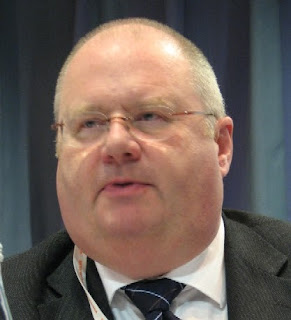
The response from the Minister of State, Theresa Villiers, was less impressive though she did point out that "Cycling can also help us to address the obesity problems that cost the NHS and wider society around £20 billion annually". She did not disagree with Mr Huppert's comments about reducing the stigma attached to cycling by lowering the apparent dangers. She should really have a quiet word with her colleague in government, Eric Pickles MP, Secretary of State for Communities and Local Government, who attended a conference last week on 'Urban Planning and Liveable Cities.'
Asked a sensible question by Mark Ames of ibikelondon Mr Pickles gave a very silly response (transcript here). He did not seem too intent upon reducing the stigma some associate with cycling by refering to pedalling in rubber knickers up and down the place to go to work. I agree cycling need not be long or arduous and does not of itself require special clothing (and I include a helmet in that). Everyday cycling in ordinary clothes is much to be encouraged. However if you are going to go far or fast (and looking at Mr Pickles he may not need to be going too far or fast to sweat profusely into his cotton Y-fronts) you will soon learn that lycra (so far as I am aware a synthesised product containing no rubber) is vastly more practicable than cotton or wool. I cannot imagine that anybody save Mr Pickles would dream of trying to cycle dressed in rubber.
As for his comment that even he might venture out eventually if we make it just a little bit safer; there is no kind way to say this Mr Pickles, but Ms Villiers's response applies to you. You are endangering your health far more by not cycling than you ever would by 'venturing out'.
If only we had a few more who did not just talk the talk but ventured out properly as Dr Huppert does, we really might start to make progress.
 So, two parliamentarians, guess which one 'ventures out' on a bicycle.
"We must encourage the police and the Crown Prosecution Service to be more ambitious in the choice of charges and the decision to prosecute, so that judges and juries can decide whether an excuse is good enough. Driving with a reckless disregard for the safety of fellow road users should be treated very seriously."
Mr Huppert goes on to deal with cycle parking, showers/lockers at workplaces, integration with public transport and then raises the subject, close to my heart, of cycle racing on the Highway.
Mr Huppert is a Liberal Democrat, the sooner he is given a job at the Department for Transport the better.
Disappointingly, at least one motoring organisation, apparently intent on seeing the sharing of roadspace as a battleground rather than a matter for cooperation, has taken exception to Mr Huppert's words. This is not a party political blog, nonetheless it is rare to find a parliamentarian of any political party talking so much unadulterated sense and Mr Huppert gets my full support.
The response from the Minister of State, Theresa Villiers, was less impressive though she did point out that "Cycling can also help us to address the obesity problems that cost the NHS and wider society around £20 billion annually". She did not disagree with Mr Huppert's comments about reducing the stigma attached to cycling by lowering the apparent dangers. She should really have a quiet word with her colleague in government, Eric Pickles MP, Secretary of State for Communities and Local Government, who attended a conference last week on 'Urban Planning and Liveable Cities.'
Asked a sensible question by Mark Ames of ibikelondon Mr Pickles gave a very silly response (transcript here). He did not seem too intent upon reducing the stigma some associate with cycling by refering to pedalling in rubber knickers up and down the place to go to work. I agree cycling need not be long or arduous and does not of itself require special clothing (and I include a helmet in that). Everyday cycling in ordinary clothes is much to be encouraged. However if you are going to go far or fast (and looking at Mr Pickles he may not need to be going too far or fast to sweat profusely into his cotton Y-fronts) you will soon learn that lycra (so far as I am aware a synthesised product containing no rubber) is vastly more practicable than cotton or wool. I cannot imagine that anybody save Mr Pickles would dream of trying to cycle dressed in rubber.
As for his comment that even he might venture out eventually if we make it just a little bit safer; there is no kind way to say this Mr Pickles, but Ms Villiers's response applies to you. You are endangering your health far more by not cycling than you ever would by 'venturing out'.
If only we had a few more who did not just talk the talk but ventured out properly as Dr Huppert does, we really might start to make progress.

Saturday, 22 January 2011
Imperial Winter Series Race 9: Saturday 22nd January
Quite a large field of at least 40 riders turned out for today’s 3rd cat race. At the sign in Lucy kindly promised me no wind, which turned out to be a half kept promise. The wind was merely strong, rather than last week’s gale, and came from the North so forming a headwind up the finishing straight. A seasonal 6ºC. Perhaps because of the better conditions, and perhaps partly also because I took the precaution of taking the train to work yesterday, I had a much better race. There were some spirited attacks including a solo attempt in the last two laps. I often get this wrong but I do not think anyone stayed away. We must have been doing a reasonable pace as we lapped the 4th cat race twice today, not something that’s happened on the races I have done in this series so far. Came in within the bunch. No crashes.
26.65 miles in 1:06:09. Average speed 24.17 mph. Max 32.3 mph
As I was leaving my fellow cycling blogger Skippy found me and we had a quick chat, curtailed by the fact I had to get home to walk the dog before dark. He is clearly doing good work finding sponsorship for paralympic athletes. It was a pleasure to meet him in the flesh. He had struggled to find the circuit so it may be worth pointing to directions here (with added bonus of a rear shot of one of my clubmates!). Hillingdon is a good place to start racing especially if you first get yourself there for some Thursday evening Prime Coaching sessions in the summer months to get used to bunch riding at speed and the layout of the circuit.
26.65 miles in 1:06:09. Average speed 24.17 mph. Max 32.3 mph
As I was leaving my fellow cycling blogger Skippy found me and we had a quick chat, curtailed by the fact I had to get home to walk the dog before dark. He is clearly doing good work finding sponsorship for paralympic athletes. It was a pleasure to meet him in the flesh. He had struggled to find the circuit so it may be worth pointing to directions here (with added bonus of a rear shot of one of my clubmates!). Hillingdon is a good place to start racing especially if you first get yourself there for some Thursday evening Prime Coaching sessions in the summer months to get used to bunch riding at speed and the layout of the circuit.
Subscribe to:
Posts (Atom)