This update has to return to the thorny issue of contributory negligence on the part of a cyclist for not wearing a cycle helmet. The issue arose in unusual circumstances in the case of Reynolds v Strutt & Parker LLP [2011]EWHC 2263. Judgment was delivered by His Honour Judge Oliver-Jones QC (sitting as a deputy Judge of the High Court – and apparently sitting in the Chancery Division!). The case has, in addition, implications for those who organise cycle races.
Mr Reynolds brought what, on the face of it, might be thought an ambitious claim against his employers for not making him wear a cycle helmet so as to protect him from the consequences of his own recklessness when taking part in a cycle race. The cycle race was organised by Mr Reynolds’s employers, a well known estate agency, and formed part of a social afternoon of team bonding. As part of the fun, Mr Reynolds and his co-workers were not told of the nature of the day’s events until they arrived at the site where the activities were to take place.
The race was between only four competitors and took place on a 3.5 km, 6 to 8 metre wide, closed road racing circuit at Fowlmead Country Park (built on the site of the former Betteshanger Colliery near Deal, Kent.)
Much of the Judgment is taken up with a discussion as to whether there was an adequate risk assessment with what appears to be an assumption all round that such an assessment should require the use of helmets. The Highway Code recommendation about helmets is not of course directly relevant since the race was not on the Highway. Instead there was reference to a Health and Safety Executive recommendation that cycle helmets be worn. Unfortunately the Judge does not indicate where this recommendation is to be found. Some of the witnesses clearly thought that there was a relevant HSE recommendation. At one point the Judge refers to ‘the recommended use of helmets by the HSE, which itself was, in my judgment ignored’ and at a later point that one witness ought to have discussed with his colleagues ‘what was said to be an HSE recommendation for the use of helmets’. There appears to have been a very curious failure to get to the bottom of what the HSE did recommend and how. I am not aware of any HSE guidance on the topic and perhaps if any reader is they would be kind enough to post a comment with the reference.
Possibly the rather sketchy consideration as to whether helmets should be worn is explained by the fact that the Claimant’s case against his employer depended upon proving that they were in breach of duty in failing to provide a helmet and the employer was in turn running a contributory negligence argument that Mr Reynolds was at fault in not wearing a helmet. Furthermore on the Defendant's version of the facts they had advised Mr Reynolds to wear a helmet. There was nobody there then to interfere with the cosy consensus that helmets should have been worn.
Obviously the competitors themselves did not have helmets (or presumably any other cycling kit) as they did not know they were going to be racing until they got to the Park. The Park had some helmets and, on the Judge’s findings, when presented with their bicycles the twelve competitors were told that helmets were available, but were not encouraged, still less required, to wear them. Apparently only one of the 12 competitors in the event wore a helmet. The deeply unattractive prospect of putting on a helmet in which somebody else has raced does not appear to have struck anybody in Court.
The 12 racers were split into groups of 4 who competed, as two teams of two, in heats so the race in which Mr Reynolds was injured started as a four horse race. It appears that Mr. Reynolds led much of the way but the tactically more savvy colleague, one Mr Cracknell, looked like passing him in the sprint for the line. The Judge found that Mr Reynolds then made a deliberate decision to prevent Cracknell passing him and forcing him to brake. ‘He was making a deliberate decision to behave in an aggressive manner, reckless as to the consequences.' As every racing cyclist knows the deliberate blocking of a rival, especially in the sprint is, absolutely not on, highly dangerous and almost certain to end in disaster. So it was in this case: Mr Cracknell was fortunately uninjured (had he been injured he could presumably have sued Mr Reynolds); Mr Reynolds unhappily was injured sustaining a serious brain injury.
Causation was addressed in as perfunctory manner as the assumed need to wear a helmet and for similar reasons. The Defendant did not have an expert at all and the Claimant had no medical evidence (described as a fundamental evidential omission by Griffith Williams J in Smith v Finch). The Claimant did have evidence form Dr Bryan Chinn (the same expert who gave evidence for Mr Smith to the effect that a helmet does not protect in a high speed impact). On this occasion he gave evidence that a helmet would have helped because the speed with which Mr Reynolds’s head struck the ground was within the range where use of a cycle helmet was effective. There was, however, a notable absence of a finding as to the speed at which Mr Reynolds’s head did strike the ground, and it seems improbable that it was less than the 12 mph standard to which helmets must conform. Possibly with an eye to the argument to be run that Reynolds was himself at fault in not wearing a helmet the Defendant ultimately conceded that the absence of a helmet was causative of some injury (how some injury differed from the actual injury was not further explored).
These findings of breach (carelessness) and causation were necessary both for a finding of liability against the Defendant employer for not encouraging/requiring the Claimant to use one of those proffered helmets and also for a finding of contributory negligence against the Claimant for not wearing one of those helmets. The ultimate division of responsibility was one third (Defendant employer) and two thirds (Claimant Mr Reynolds) so that the Claimant recovers one third of the dmages he would have got if the Defendant was wholly liable. Given that Reynolds had deliberately and recklessly blocked his opponent one has to assume that the deduction for not wearing a helmet was marginal compared to the deduction required for deliberately reckless cycling (the two elements were never separated out).
For reasons expressed above the Judgment is not really a satisfactory authority for anything. It will perhaps reinforce upon race organisers a need for a risk assessment to contain provision for requiring the use of cycle helmets. It has no sensible bearing upon the situation where a motorised vehicle collides with a cyclist.
Final thought: is it better that people race without helmets or that they do not race at all; a consideration relevant to section 1 of the Compensation Act 2006? The Judge thought requiring helmets would not put people off taking part in this type of recreational activity; maybe not if you have your own helmet.
So far as I am aware there is no appeal against this decision. In his litigation, at least, Mr Reynolds has been fortunate.
My Spring update dealt with another helmet case, Phethean-Hubble v Coles. This case is due to come before the Court of Appeal in late November though I doubt that the helmet issue will feature prominently.
Showing posts sorted by relevance for query helmet. Sort by date Show all posts
Showing posts sorted by relevance for query helmet. Sort by date Show all posts
Thursday, 22 September 2011


Thursday, 3 March 2011
Legal Update - Spring 2011
First, it's cycle helmets again. Last week His Honour Judge Wilcox sitting as a Deputy Judge of the High Court delivered his Judgment in Phethean-Hubble v Coles. On 28th November 2005, Tobias Phethean-Hubble, then aged 16, suffered severe brain injuries when he was cycling and came into collision with a Rover motor car driven by the then 17 year old Sam Coles.
Tobias's cycling was not above criticism; immediately prior to the collision he was cycling at 8pm unlit along the pavement and moved onto the carriageway of the road into the path of the Rover. The street was, however, well lit and Sam had no difficulty seeing Tobias. The failure to carry lights at night therefore only affected the outcome to the extent that it may explain why Tobias had been riding on the pavement, where the Judge observed that 'strictly' he should not have been.
The area was subject to a 30 mph speed limit. At trial there was an issue over speed with Sam accepting a speed slightly in excess of the speed limit and those representing Tobias alleging a rather greater speed. In the event the Judge found that the speed was 35 mph and found Sam to be liable for Tobais's injuries because of his excessive speed.
The Judgment is promising in that it accepts the dangers of speeding and emphasises the vulnerability of the cyclist. There was a finding that a reasonable motorist ought to have anticipated that the cyclist riding on the pavement would move into the road and a prudent motorist should have been prepared for such an eventuality and driven accordingly.
Driving 'accordingly' essentially meant moderating his speed. At 35mph there was no chance of avoiding the collision, he should not merely have been driving within the speed limit but should have slowed to 3-4 mph or so below the limit. At that speed there was a greater likelihood that the cyclist would have become aware of the approaching car in time, and the motorist would have had longer to react so as to avoid the collision, or at least cause less serious injury. Emphasis was placed on the significant difference between the two road users. One a cyclist with little protection, the other a motorist in a stable enclosed vehicle that has fatal potential.
The Judge also found fault on the part of the cyclist in riding onto the road creating the emergency. He found this was an equal cause of the accident but given Tobias's age he considered a reduction of one third for contributory negligence was just and equitable.
There was in addition criticism of Tobias for not wearing his cycle helmet. The Judge accepeted as his starting point the words of Griffith Williams J in Smith v Finch who had likened fault on the part of a cyclist not wearing a helmet to fault on the part of a motorist for not wearing a seat-belt. On the face of it this is another blow for those who wish helmet wearing to be a matter of personal choice rather than external prescription. However the authority of the decision on this point is weakened by the fact that the contrary High Court authority A v Shorrock was not cited to the Judge and, rather extraordinarily, it appears that it was not even argued on Tobias's behalf that he was not at fault in leaving his helmet at home. As it was, the Judge made passing reference to risk compensation and to the fact that helmets may sometimes make injuries worse; suggesting a distinct possibiltiy that he may not have followed Smith v Finch had the matter been argued out.
As always (at least thus far) in cases of severe impacts, the finding was then made that the wearing of a helmet would not have made a significant difference to the extent of Tobias's injuries.
Comment. Although Claimant cyclists can usually be fairly confident that a Defendant motorist will be unable to establish that a helmet would have made any difference, this is not a good reason to permit assertions that a bare-headed cyclist is at fault to go uncontested. It is inimicable to the interests of cyclists generally to allow a series of cases to build up on a premise that not wearing a helmet equates to fault. I hope that this is the last time that such an assertion will be allowed to go unchallenged.
Aside from the helmet issue though there is much in the Judgment about the standard of care owed to cyclists by motorists and about the dangers of even 'moderate' speeding to merit a cheer. I believe it to be a useful antidote to the mantra that I hear often (even sometimes from cyclists) that cyclists are just as much to blame, just as responsible etc. As I have made clear before, I personally reject this artificial 'evenhandedness' which is blind to the degree of potential to do harm to others.
[UPDATE: The Defendant's appeal against this Judgment was heard yesterday (28.11.11) and Judgment is awaited. The Defendant did not appeal the finding that a cycle helmet would have made no difference but there may well be some observations form the Court of Appeal on the degree of contributory negligence].
Death on the roads is sadly continuing at much the same rate this year, notably the 18 year old potential Olympian, Lewis Balyckyi, was run down by a Transit van and killed whilst out training in Lancashire in January.
In the criminal courts, the motorist responsible for the death of Cath Ward of Solihull CC was sentenced last December to a community order and disqualified from driving for one year. Cath had been competing in a 10 mile time trial last summer in good weather conditions on the A46 dual carriageway when she was hit from behind by a car driven by Arron Cook. Prosecutors decided to charge Cook with causing death by careless driving rather than by dangerous driving. (It is possible this case differs significantly from that of Major Gareth Rhys-Evans, see my legal review a year ago, but I do not see it as obvious from any of the reports). The result of this charging decision was that the Magistrates were empowered to, and rather unusually did, deal with the sentence themselves rather than referring to a higher Court. I continue to wish for greater consistency in charging and sentencing decisions in cases that involve killing, harming or endangering vulnerable road users.
Tobias's cycling was not above criticism; immediately prior to the collision he was cycling at 8pm unlit along the pavement and moved onto the carriageway of the road into the path of the Rover. The street was, however, well lit and Sam had no difficulty seeing Tobias. The failure to carry lights at night therefore only affected the outcome to the extent that it may explain why Tobias had been riding on the pavement, where the Judge observed that 'strictly' he should not have been.
The area was subject to a 30 mph speed limit. At trial there was an issue over speed with Sam accepting a speed slightly in excess of the speed limit and those representing Tobias alleging a rather greater speed. In the event the Judge found that the speed was 35 mph and found Sam to be liable for Tobais's injuries because of his excessive speed.
The Judgment is promising in that it accepts the dangers of speeding and emphasises the vulnerability of the cyclist. There was a finding that a reasonable motorist ought to have anticipated that the cyclist riding on the pavement would move into the road and a prudent motorist should have been prepared for such an eventuality and driven accordingly.
Driving 'accordingly' essentially meant moderating his speed. At 35mph there was no chance of avoiding the collision, he should not merely have been driving within the speed limit but should have slowed to 3-4 mph or so below the limit. At that speed there was a greater likelihood that the cyclist would have become aware of the approaching car in time, and the motorist would have had longer to react so as to avoid the collision, or at least cause less serious injury. Emphasis was placed on the significant difference between the two road users. One a cyclist with little protection, the other a motorist in a stable enclosed vehicle that has fatal potential.
The Judge also found fault on the part of the cyclist in riding onto the road creating the emergency. He found this was an equal cause of the accident but given Tobias's age he considered a reduction of one third for contributory negligence was just and equitable.
There was in addition criticism of Tobias for not wearing his cycle helmet. The Judge accepeted as his starting point the words of Griffith Williams J in Smith v Finch who had likened fault on the part of a cyclist not wearing a helmet to fault on the part of a motorist for not wearing a seat-belt. On the face of it this is another blow for those who wish helmet wearing to be a matter of personal choice rather than external prescription. However the authority of the decision on this point is weakened by the fact that the contrary High Court authority A v Shorrock was not cited to the Judge and, rather extraordinarily, it appears that it was not even argued on Tobias's behalf that he was not at fault in leaving his helmet at home. As it was, the Judge made passing reference to risk compensation and to the fact that helmets may sometimes make injuries worse; suggesting a distinct possibiltiy that he may not have followed Smith v Finch had the matter been argued out.
As always (at least thus far) in cases of severe impacts, the finding was then made that the wearing of a helmet would not have made a significant difference to the extent of Tobias's injuries.
Comment. Although Claimant cyclists can usually be fairly confident that a Defendant motorist will be unable to establish that a helmet would have made any difference, this is not a good reason to permit assertions that a bare-headed cyclist is at fault to go uncontested. It is inimicable to the interests of cyclists generally to allow a series of cases to build up on a premise that not wearing a helmet equates to fault. I hope that this is the last time that such an assertion will be allowed to go unchallenged.
Aside from the helmet issue though there is much in the Judgment about the standard of care owed to cyclists by motorists and about the dangers of even 'moderate' speeding to merit a cheer. I believe it to be a useful antidote to the mantra that I hear often (even sometimes from cyclists) that cyclists are just as much to blame, just as responsible etc. As I have made clear before, I personally reject this artificial 'evenhandedness' which is blind to the degree of potential to do harm to others.
[UPDATE: The Defendant's appeal against this Judgment was heard yesterday (28.11.11) and Judgment is awaited. The Defendant did not appeal the finding that a cycle helmet would have made no difference but there may well be some observations form the Court of Appeal on the degree of contributory negligence].
Death on the roads is sadly continuing at much the same rate this year, notably the 18 year old potential Olympian, Lewis Balyckyi, was run down by a Transit van and killed whilst out training in Lancashire in January.
In the criminal courts, the motorist responsible for the death of Cath Ward of Solihull CC was sentenced last December to a community order and disqualified from driving for one year. Cath had been competing in a 10 mile time trial last summer in good weather conditions on the A46 dual carriageway when she was hit from behind by a car driven by Arron Cook. Prosecutors decided to charge Cook with causing death by careless driving rather than by dangerous driving. (It is possible this case differs significantly from that of Major Gareth Rhys-Evans, see my legal review a year ago, but I do not see it as obvious from any of the reports). The result of this charging decision was that the Magistrates were empowered to, and rather unusually did, deal with the sentence themselves rather than referring to a higher Court. I continue to wish for greater consistency in charging and sentencing decisions in cases that involve killing, harming or endangering vulnerable road users.
Wednesday, 24 June 2015
Another case on Contributory Negligence Sinclair v Joyner
In Sinclair v Joyner [2015] EWHC 1800 Mrs Justice Cox found for the claimant cyclist in her claim for damages against the driver of a '4x4' vehicle though with a reduction of 25% to reflect the cyclist's contributory negligence.
On Sunday 3rd July 2011 Mrs Sinclair was cycling along Broadwater Forest Lane, a single carriageway lane in Kent. Coming in the opposite direction was a Volvo XC 90 motor car driven by Mrs Joyner. The two vehicles made contact as a consequence of which Mrs Sinclair fell sustaining a serious head injury.
Liability was disputed (indeed it was even faintly disputed with unsatisfactory expert evidence) that a collision had even occurred.
The Judge had no difficulty finding that the Defendant driver was liable and should have stopped to allow the cyclist to pass in safety. In words that support the view which I have frequently expressed that in England and Wales we have what approximates to a de facto presumption of liability when a motorised vehicle collides with a vulnerable road user the Judge said:
On Sunday 3rd July 2011 Mrs Sinclair was cycling along Broadwater Forest Lane, a single carriageway lane in Kent. Coming in the opposite direction was a Volvo XC 90 motor car driven by Mrs Joyner. The two vehicles made contact as a consequence of which Mrs Sinclair fell sustaining a serious head injury.
Liability was disputed (indeed it was even faintly disputed with unsatisfactory expert evidence) that a collision had even occurred.
The Judge had no difficulty finding that the Defendant driver was liable and should have stopped to allow the cyclist to pass in safety. In words that support the view which I have frequently expressed that in England and Wales we have what approximates to a de facto presumption of liability when a motorised vehicle collides with a vulnerable road user the Judge said:
- In the section dealing with "Road users requiring extra care" the Highway Code (Revised 2007 edition) draws attention, at paragraph 204, to cyclists as among those who are to be regarded as "the most vulnerable road users." Mr Martin places particular reliance upon the advice given to motorists at paragraph 212, namely "When passing motorcyclists and cyclists, give them plenty of room." While there then follows a bracketed reference to earlier rules dealing with overtaking, as Mr Freeman observes, the advice in this paragraph is, in my judgment, not confined to cases of overtaking, set as it is in the section of the Code addressing in general terms the vulnerability of these categories of road users, and the need for extra care.
- This advice is particularly pertinent in this case. The Defendant's carriageway was just 2.5 metres wide and the width of the Volvo was 2.1 metres. Even if she were right over to her nearside, and I accept that she was very close to it, that leaves at best 0.4 of a metre between the car and the Claimant who was, on the evidence, riding her bicycle still on her own side of the road but only just. She was very close to the centre as the Volvo approached and then passed her. The Claimant cyclist's close proximity to the centre of the road was noted by the Defendant as soon as she saw her, and in my view, for the reasonable prudent driver in those circumstances, alarm bells would have sounded instantly.
- Motorists have to anticipate hazards in the road, particularly from vulnerable road users, and to be ready to react to them. In my judgment the Defendant cannot be relieved of that duty of care by seeking to blame the Claimant, who was obviously in difficulty, for deviating into her side of the road and colliding with the rear offside tyre, after the front of the car had gone past her. The fact that a collision occurred demonstrates that there was not sufficient room for her to pass the Claimant safely, and that the Defendant's assumption to the contrary was in error. She ought to have appreciated that her car was too close to the centre of the road for her to have passed this cyclist safely.
Contributory Negligence
It was accepted on the Claimant's behalf that she should bear some responsibility for her injuries on the basis that 'she should not have been riding her bicycle in a central position in the road'. Mrs Sinclair's injuries did not leave her able to recall or explain her riding leading up to the accident. The matter was dealt with briefly and by concession (with the Judge accepting the Claimant's suggested 25% deduction). It should not, in my view, be taken as any indication that cyclists should not ride in a central position on the road. Indeed on the contrary they often should, though perhaps not at the point where a wide vehicle is actually passing on a country lane.
Of wider application was the further example of the Court refusing to make any finding of contributory negligence in relation to a cyclist not wearing a safety helmet. the Judge said this:
As can be seen the Defendant had no confidence in the point although it was pleaded on her behalf. Of interest is the Judge's comment that Mrs Sinclair 'was an adult enjoying a bicycle ride in the countryside on a sunny day'. Since this is plainly irrelevant to causation, this is only worth mentioning in the context of fault strongly implying that Mrs Justice Cox is not convinced that a cyclist who chooses not to wear a helmet is at fault.
Regular readers of my blog will know that Mr Martin QC was not quite right in his observation that no Court has yet decided that failing to wear a helmet amounts to contributory negligence. However Reynolds v Strutt & Parker was a wholly exceptional case for reasons I describe here
Overall an encouraging case though there are throw away comments regarding the oddity of riding central, standing on the pedals and 'proper clothing' for a cyclist that do leave a queasy suspicion that the sum of the knowledge in the Courtroom about cycling was less than it might have been and that Mrs Sinclair was in all probability a far more competent cyclist than she was given credit for.
The full Judgment can be read at http://www.bailii.org/ew/cases/EWHC/QB/2015/1800.html
The full Judgment can be read at http://www.bailii.org/ew/cases/EWHC/QB/2015/1800.html
Friday, 18 December 2009
The Helmet Debate Drags On
The Transport Research Laboratory has this week published a further paper on the effectiveness of cycle helmets. A long report that concludes that
"Cycle helmets would be expected to be effective in a range of accident conditions particularly the most common accidents that do not involve a collision with another vehicle, often simply falls or tumbles over the handlebars and also when the mechanism of injury involves another vehicle glancing the cyclist or tipping them over causing their head to strike the ground."
It would, I suppose, be genuinely astonishing if it were found that helmets were of no use in protecting the head in any circumstance. I have a clubmate who found his particularly helpful when caught unawares by a descending carpark barrier. I sometimes have wished I was wearing mine in the kitchen when my head has contacted an open cupboard door.
The TRL report expressly says it does not deal with the vexed question of risk compensation, whereby people's behaviour changes as a consequence of seeing themselves or others as less vulnerable. Nor does it deal with the questions whether the wearing of helmets should be encouraged or mandated, but its conclusions probably mean that we should not be expecting any change in the Highway Code's advice to cyclists to wear a helmet (accompanied by a vulnerable looking cyclist cowering in the gutter).
Whether this report will provide further impetus to motor insurers to blame cyclists for head injuries because they have not worn a helmet remains to be seen. What I will say is that in no case yet has a Court determined that a cyclist both ought to have been wearing a helmet and that it would have made any difference. No deduction for contributory negligence has therefore been made by a Court to date. Cyclists and their lawyers should bear that in mind when a reduction is suggested.
I have already expressed my views on contributory negligence here. Nothing in the latest paper changes my view. It is so much more important that people cycle than that they cycle with helmets and the Australian experience demonstrates that you cannot encourage both. It is so much more important that accidents are prevented than that we are forced to look to personal protection to hope to minimise their effect.
So when we see a famous footballer taking his children out for a bicycle ride let us applaud him for getting on a bike and not attack him because he has chosen not to wear a helmet.
"Cycle helmets would be expected to be effective in a range of accident conditions particularly the most common accidents that do not involve a collision with another vehicle, often simply falls or tumbles over the handlebars and also when the mechanism of injury involves another vehicle glancing the cyclist or tipping them over causing their head to strike the ground."
It would, I suppose, be genuinely astonishing if it were found that helmets were of no use in protecting the head in any circumstance. I have a clubmate who found his particularly helpful when caught unawares by a descending carpark barrier. I sometimes have wished I was wearing mine in the kitchen when my head has contacted an open cupboard door.
The TRL report expressly says it does not deal with the vexed question of risk compensation, whereby people's behaviour changes as a consequence of seeing themselves or others as less vulnerable. Nor does it deal with the questions whether the wearing of helmets should be encouraged or mandated, but its conclusions probably mean that we should not be expecting any change in the Highway Code's advice to cyclists to wear a helmet (accompanied by a vulnerable looking cyclist cowering in the gutter).
Whether this report will provide further impetus to motor insurers to blame cyclists for head injuries because they have not worn a helmet remains to be seen. What I will say is that in no case yet has a Court determined that a cyclist both ought to have been wearing a helmet and that it would have made any difference. No deduction for contributory negligence has therefore been made by a Court to date. Cyclists and their lawyers should bear that in mind when a reduction is suggested.
I have already expressed my views on contributory negligence here. Nothing in the latest paper changes my view. It is so much more important that people cycle than that they cycle with helmets and the Australian experience demonstrates that you cannot encourage both. It is so much more important that accidents are prevented than that we are forced to look to personal protection to hope to minimise their effect.
So when we see a famous footballer taking his children out for a bicycle ride let us applaud him for getting on a bike and not attack him because he has chosen not to wear a helmet.
Thursday, 19 May 2011
Sir Alan Beith's Private Member's Bill
 Yesterday afternoon Sir Alan Beith spoke in support of his private member's Bill which would "require the Secretary of State to make provision requiring the fitting of equipment to heavy goods vehicles to eliminate driver blind spots; to make other provisions relating to the safety of cyclists, pedestrians and other road users; and for connected purposes". The Bill passed its first reading. This development, like similar proposals that achieved widespread support in the European Parliament and are now before the Commission, result directly from the hard work of the family of Eilidh Cairns.
I have said plenty on these pages already about the hazards presented to cyclists by lorries. Let us hope that the old acceptance that lorries can be permitted onto our crowded streets with 'blind spots' will soon be a thing of the past. I see that the Bill is also supported by Dr Julian Huppert, whose good sense I have already noted.
I am relieved to see sense being talked in Parliament after the disproportionate reaction to the unfortunate, but extremely rare, death of a pedestrian after being run down by a cyclist which led to Andrea Leadsom's private member's Bill earlier this year.
I have also seen this week on The One Show, James Cracknell calling for legislation mandating cycle helmets. Mr Cracknell is plainly a nice guy who cycles but he is in league with the definitely non-cycling Angie Lee (who chooses to lecture children on the hazards of cycling without a helmet rather than on the dangers of diabetes and heart disease). Despite the failure of his helmet to save him from a very serious brain injury, James Cracknell genuinely believes that he would be worse off without the helmet. He goes so far as to condemn non helmeted cyclists for not thinking of their relatives. What I cannot understand is where were the thoughts for Mr Cracknell's relatives on the part of the lorry driver who apparently slammed his wing mirror into the back of James's head at 70 mph? I would be interested in a follow up story that indicates whether this driver is now languishing in a prison cell or still driving a truck. I cannot understand why some are more focussed upon the dubious benefits of a helmet rather than on ensuring that these lorry/cyclist collisions do not happen. I applaud Sir Alan for grasping the right end of the stick.
Tuesday, 21 August 2012
Camera Reviews
On my cycling commutes I like to record the action around me onto camera. Over the last several months I have been experimenting with different cameras. Different users will have different uses and purposes but, for what it is worth I tender my thoughts on the cameras I have tried.
Veho Muvi with sports kit.

Basic cheap camera with, I think, very reasonable quality of vision and sound for the price. Ease of editing files is, for me, very important as I do not wish to spend all day reviewing and editing files. The Veho records onto 30 minute files of around 635MB. A relatively low capacity (4 or 8 GB) SD card will therefore take many hours of video, which can be easily cropped using Microsoft Moviemaker.
The limiting feature for my commute is the battery life. Although sometimes advertised at 2 hours I have never had this long on any of my Muvi cameras. More like 1 to 1 1/4 hours and this deteriorates with age. Mine generally last about a year before the battery life is so low I change the camera (the batteries are not replaceable and the units are relatively cheap). I bought my last one from Amazon for about £40. I did buy one once when the colour was all off but it was replaced without drama.
The sports kit enables me to place it in a 'shell' that attaches to a strap which can be run around the vents of a helmet if you wear one or attached to the bike. Be sure though to secure something through the little eye on the camera itself in case it falls out of its shell.
Daytime example: Film used to convict Scott Lomas of threatening/abusive words and behaviour.
Quality at night is obviously diminished but still useable and better than nothing.
Nighttime example. Film used to convict Levi Rayner of careless driving (and caution for threatening/abusive words and behaviour).
The camera does struggle when pointing towards the sun. Since I live southwest of where I work this is a particular problem for me and calling out the number plate is always advisable as a backup.
Likes: Inexpensive. Ease of operation. Ease of preparing files. Usable quality of video/audio..
Dislikes: Short battery life, not good in wet.
Dogcam DVIIIR
 The police cycle team spoke highly of this camera when I spent a half day with them last November and, thinking them to be experts, I ordered one. The bullet camera is mounted onto the side of a helmet (or onto googles) and a lead is run from there to the central unit. After a bit of experimenting I decided the best thing to do was place the unit in a freezer bag and drop it down the front of my jersey hoping it did not migrate too far (or pawing at myself trying to encourage it one way rather than another). The controls were out of reach but since I set the camera to run and left it that was not a great problem.
I never got on with this device. The advertised battery life of 2 hours+ never materialised for me. Mine lasted 1h19m. I tried a new battery: same result. The unit then started to record sound but no vision. When I sent it back the replacement had a blank screen with just a narrow strip at the top. The screen is used for the controls and settings and not just for playback so that unit had to go back too. Picture quality was ok but I was expecting greater things of HD. File sizes were bigger and harder to edit and to play. I had to download software to play the files.
One further considerable annoyance was that the computer cable was non-standard size, meaning I had to carry the cable around with me or use only my work or only my home computer.
I did not use it for long but here is an example picture. As you can see night time quality was not great:
Likes: None (though the Met Police like it)
Dislikes: Expensive. Hard to use. Unreliable. Not great quality (especially for HD).
Justice camera issued by 'Policewitness'

I was loaned a Justice camera to review and I have to say that once I got used to using it I have been favourably impressed. The first camera I was sent did keep shutting down unexpectedly but a replacement was fine and it is possible that the fault lay in the SD card I was using rather than the camera. Picture quality in daytime is good though at night mediocre. The camera can be set to record in files that are whatever length you wish. The default is only 60 seconds which is too short as the film skips half a second between files and this is always at a critical moment.
It is easy to use. Just two buttons on it and the back screws off to reveal the standard mini USB port and SD card slot with a reset button (which is quite frequently needed to 'reboot' the camera).
The camera comes with mounts for helmet and bike frame though I had to rig something together for a rear view as the frame attachment only adjusts in one dimension (which leaves it pointing down if attached to a seat tube)..
Battery life is comfortably sufficient for my 2 hour commute. For reliable use though I find that I do need to use a 16GB SD card.
One thing I do like about this camera is that (like the Veho but unlike the Contour) it has a similar focal length to the human eyeball so what you see on the film is much as it looks in real life.
Example, the driver of this van was required to attend a driver improvement course:
Like the Veho it struggles when pointing towards the sun (this vehicle remained unidentified) and nightime use is not great either
Another minor irritiation is that, I find, the time and date needs to be reset at regular intervals if you wish it to remain accurate.
I find it very good as a rear view camera (though you will see a skip here):
The idea of policewitness is to engage an enterprising ex-police officer to report road crime and shove the police into taking action. Shame it has come to that but, given the level of interest in most police forces in prosecuting bad driving, I fear that it has. Google 'Policewitness' for further details.
Likes: Ease of use, picture quality (daytime), battery life, focal length.
Dislikes: Skips between files, occasionally needs resetting, time/date drifts off.
Contour Roam

Well this I thought ought to be the bee's knees and youtube is full of cyclists (like the famous Gaz) who use and recommend it. It can be fitted to a helmet but is relatively bulky and I fit to the bike frame. It records in files that are approximately half an hour long and absolutely gynormous. (3.66GB). I will only play with these files if I feel I absolutely have to and have only managed to send the police stills when reporting an incident. Contour provides some software called 'Storyteller' which is basically useless. you can see the files but not edit them and I can not even get their 'Awesome' feature (whereby you should be able to upload part of a file to youtube) to work.
Only the Windows MovieMaker on my newest computer (latest version) can handle the .mov files and these take overnight to load before stills or shorter clips can be taken.
So this camera gives you the highest quality but at the expense of useability. If you have the patience to spend hours editing your film footage then this is the camera for you.
One serious drawback though is that the lens is very wide angle. this means you will not miss much in the fisheye world but that, when you show the police footage of a vehicle passing 6 inches from you, they will have every excuse to say 'that was not so close'.
Likes: Picture quality. Ease of use (of camera)
Dislikes: Ease of use of files. Fisheye effect. Pricey. Software.
Conclusions
I use the Justice camera a great deal and have it set up rear facing on my commuter bike. I have the Contour forward facing on the handlebars but because i would much rather not have to look at those files I back this up with the old cheap but good value Muvi camera on the front.
Veho Muvi with sports kit.

Basic cheap camera with, I think, very reasonable quality of vision and sound for the price. Ease of editing files is, for me, very important as I do not wish to spend all day reviewing and editing files. The Veho records onto 30 minute files of around 635MB. A relatively low capacity (4 or 8 GB) SD card will therefore take many hours of video, which can be easily cropped using Microsoft Moviemaker.
The limiting feature for my commute is the battery life. Although sometimes advertised at 2 hours I have never had this long on any of my Muvi cameras. More like 1 to 1 1/4 hours and this deteriorates with age. Mine generally last about a year before the battery life is so low I change the camera (the batteries are not replaceable and the units are relatively cheap). I bought my last one from Amazon for about £40. I did buy one once when the colour was all off but it was replaced without drama.
The sports kit enables me to place it in a 'shell' that attaches to a strap which can be run around the vents of a helmet if you wear one or attached to the bike. Be sure though to secure something through the little eye on the camera itself in case it falls out of its shell.
Daytime example: Film used to convict Scott Lomas of threatening/abusive words and behaviour.
Quality at night is obviously diminished but still useable and better than nothing.
Nighttime example. Film used to convict Levi Rayner of careless driving (and caution for threatening/abusive words and behaviour).
The camera does struggle when pointing towards the sun. Since I live southwest of where I work this is a particular problem for me and calling out the number plate is always advisable as a backup.
Likes: Inexpensive. Ease of operation. Ease of preparing files. Usable quality of video/audio..
Dislikes: Short battery life, not good in wet.
Dogcam DVIIIR

I never got on with this device. The advertised battery life of 2 hours+ never materialised for me. Mine lasted 1h19m. I tried a new battery: same result. The unit then started to record sound but no vision. When I sent it back the replacement had a blank screen with just a narrow strip at the top. The screen is used for the controls and settings and not just for playback so that unit had to go back too. Picture quality was ok but I was expecting greater things of HD. File sizes were bigger and harder to edit and to play. I had to download software to play the files.
One further considerable annoyance was that the computer cable was non-standard size, meaning I had to carry the cable around with me or use only my work or only my home computer.
I did not use it for long but here is an example picture. As you can see night time quality was not great:
Likes: None (though the Met Police like it)
Dislikes: Expensive. Hard to use. Unreliable. Not great quality (especially for HD).
Justice camera issued by 'Policewitness'
I was loaned a Justice camera to review and I have to say that once I got used to using it I have been favourably impressed. The first camera I was sent did keep shutting down unexpectedly but a replacement was fine and it is possible that the fault lay in the SD card I was using rather than the camera. Picture quality in daytime is good though at night mediocre. The camera can be set to record in files that are whatever length you wish. The default is only 60 seconds which is too short as the film skips half a second between files and this is always at a critical moment.
It is easy to use. Just two buttons on it and the back screws off to reveal the standard mini USB port and SD card slot with a reset button (which is quite frequently needed to 'reboot' the camera).
The camera comes with mounts for helmet and bike frame though I had to rig something together for a rear view as the frame attachment only adjusts in one dimension (which leaves it pointing down if attached to a seat tube)..
Battery life is comfortably sufficient for my 2 hour commute. For reliable use though I find that I do need to use a 16GB SD card.
One thing I do like about this camera is that (like the Veho but unlike the Contour) it has a similar focal length to the human eyeball so what you see on the film is much as it looks in real life.
Example, the driver of this van was required to attend a driver improvement course:
Like the Veho it struggles when pointing towards the sun (this vehicle remained unidentified) and nightime use is not great either
Another minor irritiation is that, I find, the time and date needs to be reset at regular intervals if you wish it to remain accurate.
I find it very good as a rear view camera (though you will see a skip here):
The idea of policewitness is to engage an enterprising ex-police officer to report road crime and shove the police into taking action. Shame it has come to that but, given the level of interest in most police forces in prosecuting bad driving, I fear that it has. Google 'Policewitness' for further details.
Likes: Ease of use, picture quality (daytime), battery life, focal length.
Dislikes: Skips between files, occasionally needs resetting, time/date drifts off.
Contour Roam

Well this I thought ought to be the bee's knees and youtube is full of cyclists (like the famous Gaz) who use and recommend it. It can be fitted to a helmet but is relatively bulky and I fit to the bike frame. It records in files that are approximately half an hour long and absolutely gynormous. (3.66GB). I will only play with these files if I feel I absolutely have to and have only managed to send the police stills when reporting an incident. Contour provides some software called 'Storyteller' which is basically useless. you can see the files but not edit them and I can not even get their 'Awesome' feature (whereby you should be able to upload part of a file to youtube) to work.
Only the Windows MovieMaker on my newest computer (latest version) can handle the .mov files and these take overnight to load before stills or shorter clips can be taken.
So this camera gives you the highest quality but at the expense of useability. If you have the patience to spend hours editing your film footage then this is the camera for you.
One serious drawback though is that the lens is very wide angle. this means you will not miss much in the fisheye world but that, when you show the police footage of a vehicle passing 6 inches from you, they will have every excuse to say 'that was not so close'.
Likes: Picture quality. Ease of use (of camera)
Dislikes: Ease of use of files. Fisheye effect. Pricey. Software.
Conclusions
I use the Justice camera a great deal and have it set up rear facing on my commuter bike. I have the Contour forward facing on the handlebars but because i would much rather not have to look at those files I back this up with the old cheap but good value Muvi camera on the front.
Wednesday, 7 July 2010
"What's that camera doing on your head?"
For the last few weeks I have been commuting with a small camera fixed to my helmet (have I at last found a useful purpose for a helmet?). For less than the cost or inconvenience or discomfort of a helmet, I can gather some evidence of the very poor driving that goes on around me.
Of course it cuts both ways and in the (I like to think incredibly unlikely) event that I were to cycle dangerously and, for instance, bowl into a pedestrian on a pedestrian crossing the evidence would be there to convict me. I wish all motor vehicles carried some form of tamper proof visual and/or other record of how they were being driven.
I used the camera recently to demonstrate how I tackle dual carriageways. Of course things do not always work out smoothly. Here is an example, in the same location, of a large van coming straight at me, initially I move out further but then I am forced to the side of the road. Riding as I do, I run virtually no risk of not being noticed but I do have to react smartly to drivers like this.
Yesterday I am fairly sure the existance of my camera, once spotted, saved me from a potentially threatening situation. (Forgive my uncharacteristic expletive at the beginning - the adreneline flows when a car gets a few inches behind and honks).
I try to post incidents of good as well as bad driving but sadly there is far more that is noticeably bad than noticeably good out there.
In cases of bad driving if I can identify an employer I will contact them, as I have found that effective in the past. I have given on this blog an example of Royal Mail but I have also in the last few days contacted AXA Insurance (Rescue24) and Tellings Golden Miller (buses).
I am grateful for the comment that pointed me towards the metropolitan police site at www.met.police.uk/roadsafelondon. I could swamp them with reports but will instead try to reserve for them the worst examples. My commute actually takes me through Berkshire (Thames Valley Police), Surrey (Surrey police) and London (Metropolitan Police). Surrey has a site to report bad driving at http://www.drivesmartsurrey.org.uk/ and I have reported the white van on there.
After the initial sample I do not intend to overburden this blog with video footage. Far more can be found on Youtube where I post under the name 'Givecyclistsroom'. Even this is a mere selection as it takes time to select and upload footage. I am thinking of adopting the approach of emperors at the Roman arena and reporting those which outside observers consider bad - so if you so think please make a comment.
Finally is some of this aggressive bad driving a response to the way I ride? I have discussed this here previously. I have finally reached the top of a waiting list for cycle training and have a couple of hours booked for later this month. I will be sure to raise road positioning and defusing driver aggression with my instructor.
Of course it cuts both ways and in the (I like to think incredibly unlikely) event that I were to cycle dangerously and, for instance, bowl into a pedestrian on a pedestrian crossing the evidence would be there to convict me. I wish all motor vehicles carried some form of tamper proof visual and/or other record of how they were being driven.
I used the camera recently to demonstrate how I tackle dual carriageways. Of course things do not always work out smoothly. Here is an example, in the same location, of a large van coming straight at me, initially I move out further but then I am forced to the side of the road. Riding as I do, I run virtually no risk of not being noticed but I do have to react smartly to drivers like this.
Yesterday I am fairly sure the existance of my camera, once spotted, saved me from a potentially threatening situation. (Forgive my uncharacteristic expletive at the beginning - the adreneline flows when a car gets a few inches behind and honks).
I try to post incidents of good as well as bad driving but sadly there is far more that is noticeably bad than noticeably good out there.
In cases of bad driving if I can identify an employer I will contact them, as I have found that effective in the past. I have given on this blog an example of Royal Mail but I have also in the last few days contacted AXA Insurance (Rescue24) and Tellings Golden Miller (buses).
I am grateful for the comment that pointed me towards the metropolitan police site at www.met.police.uk/roadsafelondon. I could swamp them with reports but will instead try to reserve for them the worst examples. My commute actually takes me through Berkshire (Thames Valley Police), Surrey (Surrey police) and London (Metropolitan Police). Surrey has a site to report bad driving at http://www.drivesmartsurrey.org.uk/ and I have reported the white van on there.
After the initial sample I do not intend to overburden this blog with video footage. Far more can be found on Youtube where I post under the name 'Givecyclistsroom'. Even this is a mere selection as it takes time to select and upload footage. I am thinking of adopting the approach of emperors at the Roman arena and reporting those which outside observers consider bad - so if you so think please make a comment.
Finally is some of this aggressive bad driving a response to the way I ride? I have discussed this here previously. I have finally reached the top of a waiting list for cycle training and have a couple of hours booked for later this month. I will be sure to raise road positioning and defusing driver aggression with my instructor.
Saturday, 4 February 2012
My personal journey with the bicycle
Reading ‘The Times’ this morning, and in particular the article by newscaster Jon Snow, got me reminiscing about the history of my relationship with bicycles. It is approaching 10 years since I got into cycling in a major way and I hope you will forgive this uncharacteristically personal story.
Jon Snow and I met on a bike ride around Blois
Until 2002 the extent of my cycling was to cycle the 5 miles from my home in Earl’s Court to my work in The Temple, on an old battered bicycle. I was terrified of traffic and my route took me through quiet sidestreets through parks and even (I now shudder to recall) along some pavements. I invariably wore ‘ordinary’ clothing. It would take me around half an hour to cover that distance. I was unfit, slow and posed no danger even to pedestrians. I felt I was doing my bit for the environment and to keep fit. Devoting the hours I now do to cycling was in those days completely unthinkable with the twin demands of trying to make my way in my profession and of a young family. I cycled but had no real interest in cycling. I had only the vaguest idea who Lance Armstrong was, or when the Tour de France took place, and had no real conception that sportsmen, let alone ordinary cyclists, could easily travel distances of the order of 100 miles.
However I was prepared to make an effort for this charity ride. I went along to my local bike shop (I had now moved to Berkshire ) and bought the cheapest road bike they had. It felt very awkward having drop handlebars and such skinny tyres and I struggled with learning how to change gears through manipulating the brake levers. Not only did I accept advice as to the bike, I also bought a pair of cycling shorts though these were always safely concealed under an outer garment. I cycled this bike through parks and cycle tracks to Staines , 10 miles off, each morning and then put my bicycle in the guard’s van, back in the days when cycles on trains and rush hour were not mutually exclusive.
On 7th April 2002 I started the 100 mile ride with Jon in the Loire countryside. Jon had all the kit and a bike that cost more than I imagined a bike could. He laughed at me in my old boat shoes. I reciprocated with astonishment at his ‘clipless’ pedals, I had seen nothing like them and he patiently explained their advantages. To Jon’s mild surprise I kept up with the lead group on this ride and even chased them down successfully after I had had to detach and discard my plastic toe straps (into a bin, Mr Parris, if you are reading) which were disintegrating under the strain of the ride.
Once I got home new pedals were required so I returned to the local bike shop and got some ‘clipless’ ones. After a few embarrassing falls I never looked back. I kept cycling to Staines because I enjoyed it and even sometimes beyond though my continuing fear of traffic made it difficult to advance far into London Cambridge
Early in the process of becoming a cyclist I suffered the worst ‘accident’ I have yet had on a bicycle. I was travelling to Staines one morning along a cyclepath. The cyclepath took me onto a roundabout for a right turn towards Staines . A motorist, who did not expect me or see me, came from my left broadside into me. My precious first roadbike was folded in half under her wheels while I got a sharp smack to the hip from her front and a second sharp smack to my shoulder from her windscreen before being thrown forward onto the tarmac as she finally braked.
It was entirely her fault not giving me priority on that roundabout. However the accident would not have occurred had I not been so fearful of traffic. When I cover the same route now I am not on the cycletrack emerging from a little used road onto the roundabout, I am on the main road, dominating my lane where I cannot fail to be seen. I read John Franklin’s excellent book ‘Cyclecraft’, trained to Bikeability 3 and became a fully converted vehicular cyclist. I have had a couple of minor collisions with careless motorists since but they have been anticipated and controlled, and have left me with no significant injury. The three occasions I have needed medical treatment since the Staines crash have all followed from my sliding to the ground in icy or greasy conditions when I have been pushing the boundaries.
So, since I became a ‘vehicular’ cyclist I have had no serious collisions with traffic. I have however been shouted at, abused and even, once, assaulted. An explanation, though certainly no excuse, for this is that many motorists and even some cyclists do not understand my positioning. I will, when my safety requires it (which is much of the time), take the primary road position (centre of leftmost lane relevant to my direction of travel) and never ride closer to the kerb than the secondary position - a fluid concept but broadly about ½ metre left of the traffic flow (where the vehicles would put their nearside wheels if you were not there) but never (ok, hardly ever, and usually I have regretted the exceptions) closer than ½ metre from the kerb. This naturally leads to avoidance of the lethal undertaking manoeuvre (forget the red lights it is the cyclists who undertake me, six inches from the kerb, when I am slowing for a hazard or even indicating to turn left, that wind me up).
Getting back to The Times, I have praised their campaign and like tens of thousands of others signed up my support. Their guide to safe cycling does make the point about positioning but it is a bit half-hearted compared (say) to the advice to wear a helmet. Point 3 is that ‘Some cycling instructors say that your primary cycling position should be in the middle of the road and your secondary position to the left’. This gives the impression it is potentially a minority view and so far as I am aware it is not. Every suitably qualified instructor will surely agree that the primary position is in the middle of the lane. By contrast Point 1 in the same guide is to be sure you have the right kit namely, Helmet, High viz jacket. Over the page is a double spread about James Cracknell and his belief that cyclists who are not wearing helmets are irresponsible and selfish. No some people believe you should wear a helmet about this
Vehicular cycling is though not an easy solution for everybody. The main reason for this, however, is because too few motorists understand Bikeability training. If they did and it were part of the requirements for a driving licence, then surely the old and the young as well as the bloody-minded would find it easier to do what was universally expected of them rather than to do what is currently regarded with suspicion or even aggression. It is not, in my view, inherently difficult for bicycles and cars to share the road once everyone is clear about the rules.
This brings me finally to Jon Snow’s contribution, I am very favourably disposed towards Jon who I have explained was an inspiration to me 10 years ago (and I love it when I hear him on TV mentioning that he hopped on his bike to interview the Prime Minister/President of the World Bank/Pope or whomever). I agree with his article entirely until he gets to the point where he says cars and bikes do not mix and cannot share the same road, he argues for segregation. I can see the force of providing infrastructure which will lessen the perception of hazard to would be cyclists. However saying cars and bicycles cannot mix is perilously close to the motorist view, which I have encountered, that cyclists should not be on the road. I am left worrying today that this could all develop into an emphasis on danger, helmets and segregation.
I have referred to everybody knowing the rules. This to me is key, as is enforcing the rules. This is the part that is too often glossed over. Rebecca Romero has it right in her contribution when she says that the critical thing is respect for road users who aren’t in motorised vehicles. ‘I think the penalties for causing injury or death on the road are far too light. The consequences-the deterrent-have to be massive’. I am encouraged to note that this is a stand being taken by British Cycling following the tragic death of Rob Jefferies in Wareham
Is it divisive, going around as I do expecting motorists who endanger or threaten me to face consequences for their actions? I do not think so. There is a small but dangerous core of motorists who are actively hostile to the presence of cyclists on the road. For some, education and explanation may never be enough to alter their attitudes and behaviour. Appeasement never works and ultimately these people should be denied the privileges conferred by a licence to drive.
Saturday, 1 October 2011
What's that camera doing on your head (Part 2)?
It has been nearly 15 months since I last answered this question. Since then I have filmed two incidents that have resulted in prosecutions in the Magistrates' Courts (neither yet concluded) and have some footage of a collision which could be useful in the event that liability for the damage becomes an issue. The camera, modest as it is, has served a useful purpose.
Alas, I did not have my camera when I was assaulted on a Sunday club run but I read from The Dartford Messenger that as a consequence of helmet camera footage, the man who assaulted a cyclist in Bexley has been convicted and punished. This follows the conviction of a motorist in Manchester of assaulting a cyclist and driving without due care as reported in The Manchester Evening News. There is no doubt that neither criminal would have been brought to justice without helmet camera footage. Incidently the Bexley case leads me to nominate for judicial hero of the year District Judge Roger Ede who commented that:
“Cyclists are very vulnerable and they feel exposed and feel threatened when a car comes too close to them. Car drivers need to respect cyclists and understand that.”
Alas, I did not have my camera when I was assaulted on a Sunday club run but I read from The Dartford Messenger that as a consequence of helmet camera footage, the man who assaulted a cyclist in Bexley has been convicted and punished. This follows the conviction of a motorist in Manchester of assaulting a cyclist and driving without due care as reported in The Manchester Evening News. There is no doubt that neither criminal would have been brought to justice without helmet camera footage. Incidently the Bexley case leads me to nominate for judicial hero of the year District Judge Roger Ede who commented that:
“Cyclists are very vulnerable and they feel exposed and feel threatened when a car comes too close to them. Car drivers need to respect cyclists and understand that.”
Using a camera does though court a degree of controversy, even amongst the odd fellow cyclist. Some argue that those with cameras go out 'looking for trouble' or that they 'bring trouble on themselves', or that their expectation that the laws there to protect them be obeyed and enforced is insufferably self-righteousness. Others claim that they avoid all trouble through their superior riding skills and calm state of mind. I find it difficult to accept that any cyclist would look for trouble; there is simply too much at stake, and I am frankly astonished at how ready some people are to blame cyclists for any dangerous driving or other aggression that takes place around them. We surely want more people to take to cycling and they will, by definition, start off as inexperienced. How many will persevere in the face of experiences like the following?
It is impossible to convey how intimidating this is without camera footage and I defy anybody to explain how this is the fault of anybody but the lorry driver's, or how calm acceptance on the part of the cyclist (that's me) of current conditions on the roads would have helped prevent this.
I do not see how it can be anything but good for all cyclists to have this standard of driving brought to the driver, his employer's and the police's attention.
UPDATE 19.01.12. Since I wrote the above both the Magistrates' Court cases mentioned above have been concluded. Scott Lomas was convicted of a Public Order Offence committed near Hounslow and charges were dropped against Christopher Bootle for (alleged) inconsiderate driving in Staines because on review of the file it was discovered that the necessary notice of intention to prosecute had not been served.
It is impossible to convey how intimidating this is without camera footage and I defy anybody to explain how this is the fault of anybody but the lorry driver's, or how calm acceptance on the part of the cyclist (that's me) of current conditions on the roads would have helped prevent this.
I do not see how it can be anything but good for all cyclists to have this standard of driving brought to the driver, his employer's and the police's attention.
UPDATE 19.01.12. Since I wrote the above both the Magistrates' Court cases mentioned above have been concluded. Scott Lomas was convicted of a Public Order Offence committed near Hounslow and charges were dropped against Christopher Bootle for (alleged) inconsiderate driving in Staines because on review of the file it was discovered that the necessary notice of intention to prosecute had not been served.
Thursday, 28 June 2012
Helmets: a Dutchman goes to Canada
Hans Voerknecht has been to a Velo-City conference in Vancover to explain why mandatory helmet laws are not such a great idea. One of his statistics is that In the Netherlands, where cycling is ubiquitous, 13.3 per cent of the cyclists admitted to hospitals with injuries wore helmets — even though just 0.5 per cent cent of Dutch cyclists wear helmets. Maybe tourists from Anglo Saxon nations wearing helmets are disproportionately represented in the hospital statistics. Maybe also those with helmets are perceived by motorists or perceive themselves to be less vulnerable. The debate will go on.
Meanwhile I am reminded that earlier this year a Metropolitan Police Officer stated to me, during the course of the same conversation in which he explained that his officers were under a high workload so it was difficult to deal with law breaking motorists, that he would like to see helmet compulsion here. He did not seem to think there would be any problem with the Metropolitan Police finding the resources to enforce any such law and I bet he would be right. Where there is a will, there is a way.
Monday, 29 March 2010
PIBA Annual Conference 2010
I have just returned from the Personal Injuries Bar Association Annual Conference in Oxford where I presented a paper on bicycle helmets. My talk came between that of a Neuropsychologist and a Neurologist, both of whom expressed full agreement with what I said from a medical point of view. Indeed the Neuropsychologist spoke of a threshold for brain injury of 25 mph suggesting that if a blow is powerful enough to damage your brain it is twice as big as anything that a helmet can help with. This gives an answer to the 'My helmet was destroyed leaving my head undamaged' anecdote. Interestingly also the prevention of a skull fracture is not necessarily a good thing since the fracture will limit the brain damage to a local lesion rather than widespread damage.
The paper can be downloaded here or here.
The paper can be downloaded here or here.
Thursday, 27 September 2012
My Season Ends with a Bang
Regular readers will know I have a great enthusiasm for road racing. Certainly my enthusiasm exceeds my aptitude. There is an element of risk of course. However in 5 years I have never before crashed or, perhaps more importantly, caused a crash in a race. The racing provides an impetus for the dogged miles I put in commuting which, given the hostile environment of the roads particularly in and around Hounslow, I am hard pushed to portray as an unallured pleasure.
Lat Sunday Willesden CC put on a road race on the Great Milton Circuit in Oxfordshire. It is a course I know very well and I earmarked it some months ago as a race I could finish. Sadly I didn't.
I cannot tell you much about the race. I have only small 'islands' of memory from around 0945 to around 1600 last Sunday. Reference to my Garmin tells me I crashed at 1030 on a long wide stretch of road in Chalgrove. I have a few short snapshots of the race, one short snapshot in an ambulance, another in the ICU at John Radcliffe, Oxford, one in an MRI scanner, one in Major Injuries and finally in Minor Injuries where uninterrupted continuous memory finally returned and I waited the rest of the day to get my wounds stitched up.
The distribution of damage to my body and clothing (and the very limited damage to the bike) suggests I went down onto my head and the back of my hands (possibly still gripping the drops) then flipped onto my left shoulder and side. Eye witness accounts inform me that for no very obvious reason, a rider fell sideways into the road in front of me. I imagine my front wheel stopped more or less instantaneously on hitting him flipping me and the bike over.
I have considerable litigation experience of head injury cases so I know this was, thankfully, a minor traumatic brain injury. I can only have been unconscious for moments after the impact because I am told I started making an awful fuss, though my notes suggest I did follow this up with a 7 minute period of unconsciousness in the ambulance. The prognosis for full recovery from a minor head injury is excellent (I have a personal conviction that long term consequences from a minor head injury, as often alleged in a Court, are more likely to be psychogenic than organic, though not all neurologists would agree). It will though take a few days, as with my other injuries, to quite get back to normal. Unfortunately I have had to work over the last 3 days (though thankfully from home) but I will now be taking time off to accelerate the recovery process.
In the meantime I am stuck with low mood (why me??), anger, queasiness and irritability. The best cure for a depressed mood is getting out on my bike but that is an option that realistically is not open to me for a few days yet. I have a few months to contemplate whether I will race again. In the past when I had thought of the crash which would inevitably come some time, I had thought of roadrash, possibly a broken collar bone, not of landing forcefully onto my head with the awful risk of serious brain or spinal damage which that entails. I feel I was unlucky to the point when I was flying through the air but then I was lucky that it was not a lot worse.
Roadracing does involve a huge degree of trust in your fellow competitors. I trust all the people that I have got to know racing to handle themselves and their bikes well in a bunch. Before I started racing I spent a summer going to training sessions run weekly by Prime Coaching at Hillingdon. I highly recommend such preparation to any one who is considering taking up racing for the first time.
I suppose I have got to mention my helmet. It is mangled. Did it save my life as the nurse in the minor injuries unit confidently asserted to me? I am sceptical. My brain injury was caused by the sudden deceleration of my head which I doubt the helmet did much to ameliorate. Certainly it saved me lacerations and roadrash to the scalp. As always it is wiser to seek to avoid the impact rather than to put one's faith in protective gear.
Apologies to those who you who have found normal service to my blog interrupted. Finally thanks to the road race organisers, first aiders, marshals, passers-by, fellow racers (especially the few who stepped forward with accounts of what happened) and wife who picked up the pieces.


Postscript: the rider who fell in front of me was permitted to leave the scene and was not identified in any subsequent incident report. Accordingly neither I, nor British Cycling officials, will ever know what caused him to fall, save that it was getting wet and his rear wheel was seen to slip outward. I feel it is a pity that he was not asked for an explanation and, if appropriate, given advice. All of us involved in the great sport of racing should be striving to reduce the risk of this kind of incident to the lowest level we possibly can.
Lat Sunday Willesden CC put on a road race on the Great Milton Circuit in Oxfordshire. It is a course I know very well and I earmarked it some months ago as a race I could finish. Sadly I didn't.
I cannot tell you much about the race. I have only small 'islands' of memory from around 0945 to around 1600 last Sunday. Reference to my Garmin tells me I crashed at 1030 on a long wide stretch of road in Chalgrove. I have a few short snapshots of the race, one short snapshot in an ambulance, another in the ICU at John Radcliffe, Oxford, one in an MRI scanner, one in Major Injuries and finally in Minor Injuries where uninterrupted continuous memory finally returned and I waited the rest of the day to get my wounds stitched up.
The distribution of damage to my body and clothing (and the very limited damage to the bike) suggests I went down onto my head and the back of my hands (possibly still gripping the drops) then flipped onto my left shoulder and side. Eye witness accounts inform me that for no very obvious reason, a rider fell sideways into the road in front of me. I imagine my front wheel stopped more or less instantaneously on hitting him flipping me and the bike over.
I have considerable litigation experience of head injury cases so I know this was, thankfully, a minor traumatic brain injury. I can only have been unconscious for moments after the impact because I am told I started making an awful fuss, though my notes suggest I did follow this up with a 7 minute period of unconsciousness in the ambulance. The prognosis for full recovery from a minor head injury is excellent (I have a personal conviction that long term consequences from a minor head injury, as often alleged in a Court, are more likely to be psychogenic than organic, though not all neurologists would agree). It will though take a few days, as with my other injuries, to quite get back to normal. Unfortunately I have had to work over the last 3 days (though thankfully from home) but I will now be taking time off to accelerate the recovery process.
In the meantime I am stuck with low mood (why me??), anger, queasiness and irritability. The best cure for a depressed mood is getting out on my bike but that is an option that realistically is not open to me for a few days yet. I have a few months to contemplate whether I will race again. In the past when I had thought of the crash which would inevitably come some time, I had thought of roadrash, possibly a broken collar bone, not of landing forcefully onto my head with the awful risk of serious brain or spinal damage which that entails. I feel I was unlucky to the point when I was flying through the air but then I was lucky that it was not a lot worse.
Roadracing does involve a huge degree of trust in your fellow competitors. I trust all the people that I have got to know racing to handle themselves and their bikes well in a bunch. Before I started racing I spent a summer going to training sessions run weekly by Prime Coaching at Hillingdon. I highly recommend such preparation to any one who is considering taking up racing for the first time.
I suppose I have got to mention my helmet. It is mangled. Did it save my life as the nurse in the minor injuries unit confidently asserted to me? I am sceptical. My brain injury was caused by the sudden deceleration of my head which I doubt the helmet did much to ameliorate. Certainly it saved me lacerations and roadrash to the scalp. As always it is wiser to seek to avoid the impact rather than to put one's faith in protective gear.
Apologies to those who you who have found normal service to my blog interrupted. Finally thanks to the road race organisers, first aiders, marshals, passers-by, fellow racers (especially the few who stepped forward with accounts of what happened) and wife who picked up the pieces.


Postscript: the rider who fell in front of me was permitted to leave the scene and was not identified in any subsequent incident report. Accordingly neither I, nor British Cycling officials, will ever know what caused him to fall, save that it was getting wet and his rear wheel was seen to slip outward. I feel it is a pity that he was not asked for an explanation and, if appropriate, given advice. All of us involved in the great sport of racing should be striving to reduce the risk of this kind of incident to the lowest level we possibly can.
Monday, 26 March 2012
Phethean-Hubble v Coles. The Court of Appeal and a potentially revolutionary approach to causation
A year ago I commented upon the decision of HHJ Wilcox in Phethean-Hubble v Coles. The Court of Appeal have now handed down their Judgment on Sam Coles's appeal against the finding that he was two thirds to blame for the collision which resulted in serious injury to Tobias Phethean-Hubble.
I set out the facts in my earlier commentary on HHJ Wilcox's Judgment. In brief summary the facts and findings of the trial judge were as follows:
1. Tobias (age 16) had been riding his bicycle at night without lights, and without helmet, along the pavement of a long straight road with street lights, with one carriageway in each direction and with a speed limit of 30mph.
2. Sam (age 17) was driving his mother's car in the same direction at a speed of 35mph.
3. Tobias left the pavement at an angle in order to cross to the pavement on the other side of the road. He rode into the path of the car and a collision occurred about 1.5 metres from the kerb.
4. At the speed at which Sam was travelling there was no chance of avoiding the collision.
5. Sam had seen Tobias on the pavement and should have anticipated that he might move into the road and should have moderated his speed to 3 or 4 mph below the speed limit.
6. That reduced speed would have resulted in a greater likelihood of avoiding the collision or reducing the severity of Tobias's injuries.
7. The non-use of bicycle lights or a cycle helmet made no difference to the collision or its consequences.
In the Court of Appeal, both sides appealed the Judge's findings as to Sam's speed (though the Claimant's argument that the finding should have been of faster speed was more muted than the Defendant's that the finding should have been slower). Sam had originally told the police that his speed was 'about 35mph' [My comment: an odd thing to say to a police officer about your speed in a 30 mph area if, as subsequently claimed he was in fact travelling at 30 mph, unless there is some cultural norm among motorists that a few miles an hour over a speed limit is really quite acceptable]. Perhaps therefore it is not surprising that (whatever the problems with trying to cross check this with the physical evidence) this finding was upheld.
Next, the Defendant attacked the Judge's finding that a safe speed in the circumstances was 26/27 mph. Again, though with 'considerable anxiety' the Court of Appeal upheld this finding. [My comment: it would have been an easier finding had the Judge been more, rather than less, ambitious. In the context of his finding that Sam should have anticipated that Tobias might ride into the road, slowing to 20mph might have made some meaningful difference. The Court's anxiety appears to have related to this fine tuning of a figure so close to the speed limit. But this perhaps endows the speed limit with too much importance. The determination of a safe speed depends upon the circumstances; it will very often be slower than the limit (and even according to some of the older cases higher than the speed limit). At all event the Judge's finding was that Sam should have been going some 20% slower than he was].
The next point was the one of greatest danger for Tobias; that was, would the slower speed have made any difference. The Judge had, at best, expressed himself unsatisfactorily when talking about 'likelihoods' when our law of causation requires these matters to be determined on the balance of probabilities. The finding more happily expressed would be that it is more likely than not that had Sam been travelling at 26/27 mph, the collision would not have happened. The Court of Appeal accepted that that is what the Judge meant and upheld his decision that Sam's excessive speed had caused Tobias's injuries. Perhaps the most important observation to be derived from this case is that the burden of proving that Tobias's injuries would have been of similar severity even had Sam been travelling at a safe speed rested on the Defendant. Once the Claimant had established that the Defendant was in breach of his duty of care and that the Claimant had sustained an injury of the kind likely to be caused by that breach then it is incumbent upon the Defendant to disprove causation. That is potentially a significant development of the law which may be of real assistance to cyclists (and other injured Claimants).
Finally the Defendant appealed the Judge's finding that the level of contributory negligence should be one-third. The Judge had said that the degree of contributory negligence would have been one half but that it was just and equitable to reduce it because of Tobias's age. The Court of Appeal agreed with the Defendant that there was no reason to treat Tobias as if he were anything other than an adult in this respect and allowed the appeal to the extent of increasing the contributory negligence from one third to one half.
I set out the facts in my earlier commentary on HHJ Wilcox's Judgment. In brief summary the facts and findings of the trial judge were as follows:
1. Tobias (age 16) had been riding his bicycle at night without lights, and without helmet, along the pavement of a long straight road with street lights, with one carriageway in each direction and with a speed limit of 30mph.
2. Sam (age 17) was driving his mother's car in the same direction at a speed of 35mph.
3. Tobias left the pavement at an angle in order to cross to the pavement on the other side of the road. He rode into the path of the car and a collision occurred about 1.5 metres from the kerb.
4. At the speed at which Sam was travelling there was no chance of avoiding the collision.
5. Sam had seen Tobias on the pavement and should have anticipated that he might move into the road and should have moderated his speed to 3 or 4 mph below the speed limit.
6. That reduced speed would have resulted in a greater likelihood of avoiding the collision or reducing the severity of Tobias's injuries.
7. The non-use of bicycle lights or a cycle helmet made no difference to the collision or its consequences.
In the Court of Appeal, both sides appealed the Judge's findings as to Sam's speed (though the Claimant's argument that the finding should have been of faster speed was more muted than the Defendant's that the finding should have been slower). Sam had originally told the police that his speed was 'about 35mph' [My comment: an odd thing to say to a police officer about your speed in a 30 mph area if, as subsequently claimed he was in fact travelling at 30 mph, unless there is some cultural norm among motorists that a few miles an hour over a speed limit is really quite acceptable]. Perhaps therefore it is not surprising that (whatever the problems with trying to cross check this with the physical evidence) this finding was upheld.
Next, the Defendant attacked the Judge's finding that a safe speed in the circumstances was 26/27 mph. Again, though with 'considerable anxiety' the Court of Appeal upheld this finding. [My comment: it would have been an easier finding had the Judge been more, rather than less, ambitious. In the context of his finding that Sam should have anticipated that Tobias might ride into the road, slowing to 20mph might have made some meaningful difference. The Court's anxiety appears to have related to this fine tuning of a figure so close to the speed limit. But this perhaps endows the speed limit with too much importance. The determination of a safe speed depends upon the circumstances; it will very often be slower than the limit (and even according to some of the older cases higher than the speed limit). At all event the Judge's finding was that Sam should have been going some 20% slower than he was].
The next point was the one of greatest danger for Tobias; that was, would the slower speed have made any difference. The Judge had, at best, expressed himself unsatisfactorily when talking about 'likelihoods' when our law of causation requires these matters to be determined on the balance of probabilities. The finding more happily expressed would be that it is more likely than not that had Sam been travelling at 26/27 mph, the collision would not have happened. The Court of Appeal accepted that that is what the Judge meant and upheld his decision that Sam's excessive speed had caused Tobias's injuries. Perhaps the most important observation to be derived from this case is that the burden of proving that Tobias's injuries would have been of similar severity even had Sam been travelling at a safe speed rested on the Defendant. Once the Claimant had established that the Defendant was in breach of his duty of care and that the Claimant had sustained an injury of the kind likely to be caused by that breach then it is incumbent upon the Defendant to disprove causation. That is potentially a significant development of the law which may be of real assistance to cyclists (and other injured Claimants).
Finally the Defendant appealed the Judge's finding that the level of contributory negligence should be one-third. The Judge had said that the degree of contributory negligence would have been one half but that it was just and equitable to reduce it because of Tobias's age. The Court of Appeal agreed with the Defendant that there was no reason to treat Tobias as if he were anything other than an adult in this respect and allowed the appeal to the extent of increasing the contributory negligence from one third to one half.
Wednesday, 18 August 2010
Cycling in Canada

Domestic creatures (dogs) are intrigued by the unusual sight of a cyclist and are inclined to give chase; so far I have been able to outsprint them but if I encounter one going uphill a confrontation seems possible.
I am starting to stick to 'busier' roads where the occasional passing car means that owners have trained their pets to stay off the roads and the more dangerous wildlife is likely to be some way back in the woods.
Motorists here are generally highly considerate of cyclists; this may be the opposite of 'safety in numbers'. I am sufficiently unusual to be noticed and it is easier to give a cyclist plenty of space if nothing else is around and I am probably the only cyclist they pass in a week.
It is good to have challenges that differ so much from those I face on the usual commute into work.

Friday, 25 June 2010
Legal Update - Summer 2010
In the criminal courts the treatment of those who have killed cyclists has remained patchy. We all experience irrational road rage from time to time from motorists. The unfortunate cyclist, Paul Webb, was deliberately run down by a motorist, Sean Fitzgerald, apparently in retaliation for a damaged wing mirror. Mr Webb died of his injuries. Fitzgerald claimed this was an accident. Unhappily for Fitzgerald, but happily for justice, two workmen in a nearby driveway heard the engine noise followed by the collision and the jury rejected Fitzgerald's defence. Fitzgerald was convicted of murder, sentenced to life and will serve a minimum of 13 years. This is a first, so far as I am aware, of a murder conviction for a motorist who has run down a cyclist. I have an uneasy feeling that Fitzgerald is far from the first, or last, motorist to attack a cyclist in this way but if the cyclist is dead, it is often difficult to challenge the motorist's version of events.
44. In my judgment, although it is illegal for cyclists to use the pavement (unless it is specifically sanctioned by a local authority for shared use), when weighing up the danger to himself (cp danger to pedestrians) it was a reasonable decision by the Claimant to ride on the pavements in this area rather than the road in the context of the duty of care owed to himself to take reasonable care for his own safety whilst cycling. In my judgment, although illegal and potentially negligent in any action vis a vis a pedestrian, it was not “blameworthy” in terms of negligence in contributory negligence."
So there we have it, judicial confirmation that the facilities for cyclists are so poor that they can reasonably decide to travel illegally on the pavement. I suspect Mr Kotula was wearing a helmet (because the report does not state otherwise) but there is also here further ammunition to use against those who argue that a cyclist is guilty of contributory negligence if he does not wear a helmet:
"50. In any event, even if contributory negligence had been established here, the relative culpability and causative potency of the alleged negligent acts of the Defendants and the Claimant under the principles in Davies v Swan Motor Co. (Swansea) Ltd. [1949] 2KB 291 were such that those of the Defendants were overwhelming: their negligence potentially threw users of the pavement into the path of vehicles on the carriageway; whereas the Claimant was rightly or wrongly using the pavement in the first place to try and avoid uncomfortable proximity with those very vehicles."
In the other civil case, which also came before HHJ Brown, the widow of Ninian Donald, claimed damages against the driver of a skip lorry that crushed Mr Donald as it turned left at traffic lights in Hackney in May 2007. The Defendant accepted 75% of the blame for the accident and damages were agreed, and approved by the judge, on that basis. This is a tragically common type of incident especially in London. Interestingly at the inquest the investigating police had no hesitation in heaping the entirety of the blame on Mr Donald.
I have commented before on the adequacy of police and coroners' investigations into the deaths of cyclists. Earlier this week I met up with a lot of lawyers, medics, bereaved and others interested in the legal investigations of death. It strikes me that there is a hierarchy of deaths; sterling and thorough work (not least by Coroners) goes into the investigation of deaths in custody (including those detained by UK forces abroad), deaths of soldiers, deaths in the workplace. The public funds, and rightly so, investigation and legal representation of the highest quality to take on such cases. Typically those involved in the coronial system at this level are favourably impressed. Relatives of the victims of Road Traffic Collisions are almost universally far less impressed. My own explanation for this is that our society is car dominant. Deaths in a factory or building site or an unnatural death whilst detained by the State are a disgrace and should not happen: deaths on the road, well that's the inevitable price we pay for enjoying our motor vehicles. The unnatural violent death of any individual is equally important. I wish we could move up the list of priorities at least those vulnerable road users who pay the ultimate price for taking up the Government's exhortations to walk or cycle.
In my last update I described the fate of Katie Hart (who ran down and killed Major Gareth Rhys-Evans) and described her prison sentence as 'inevitable'. It appears I need to revise my idea of what is inevitable. Yesterday Georgina Mills walked free from Exeter Crown Court following her conviction of causing death by dangerous driving. Last September she had run down two cyclists on the A30 in Tedburn St Mary. The cyclists were on a long distance ride for charity and one of them, Simon Evans, died from his injuries. Mills admitted the charge of causing death by dangerous driving (a factor that differentiates her case from Hart) and expressed remorse. She was ordered to do unpaid community work and was (like Hart) disqualified from driving for just two years.
Mills had apparently been distracted for two seconds by a spider. Presumably if you take your eyes off the road to deal with a spider you slow down, but even if Mills continued at 60 mph and hit the cyclists at the very end of the two seconds, she would have been only 53 metres from the pair when she first took her eyes off the road. I do not know the precise location of the collision but Google Earth reveals this to be a straight wide dual carriageway.
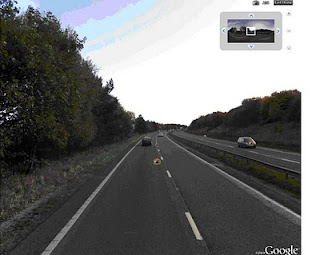

53 metres is certainly less distance than the nearest car is away in this Google Streetview. It is not, in my view, very helpful to characterise this type of accident as 'momentary inattention' since that can be applied almost universally to road traffic collisions. I strongly suspect that the cyclists must have been there to be seen before the motorist was distracted by the spider. The underlying problem is that she did not take in, or react appropriately, to the presence of cyclists on the road. The brain ought to have already started to process the achievement of the task ahead, namely to overtake two cyclists in a safe way. Slowing and planning a move to the offside should already have been happening. To add to the horror, the surviving cyclist was able to give evidence that both bicycles had been to the nearside of the rumble strip which, at least superficially, may appear to be the safest place to be. This is wholly understandable and obviously no scintilla of blame could possibly be ascribed to the cyclists. I have many times stated on these pages how I deal with dual carriageways
and sometimes those I am with (and certainly some motorists) think me mad - but I would rather the motorist's brain processed "What is that nutter doing in the middle of my lane?" than processed nothing at all. Ultimately if the driver kept coming I would have been onto the grass verge. There is no safety at the side of the road; some motorists will act as though you are not there and you cannot tell at the edge whether they are going to hit you or pass you until it is too late.
and sometimes those I am with (and certainly some motorists) think me mad - but I would rather the motorist's brain processed "What is that nutter doing in the middle of my lane?" than processed nothing at all. Ultimately if the driver kept coming I would have been onto the grass verge. There is no safety at the side of the road; some motorists will act as though you are not there and you cannot tell at the edge whether they are going to hit you or pass you until it is too late.
Of course this strategy requires looking behind almost more than looking ahead and is incompatible with Time Trialing. It pains me to report that there has been yet another death of a Time Trialist, this time on the A419 dual carriageway near Swindon. At about 7.45 pm on June 12th Alex Anderson was struck by a car and later that night died in hospital. Traffic is reported to have been exceptionally light, perhaps due to a football match that England was playing at the time in South Africa. I will be keeping an eye out for any proceedings that come out of this but make no further comment now.
In the civil courts there have been two recent cases of note. In Kotula v EDF & others on 6th June 2010 HHJ Simon Brown (sitting as a deputy High Court Judge) gave a Judgment in favour of a cyclist who had suffered catastrophic injuries when he fell into the road under a lorry whilst trying to negotiate some poorly sited barriers erected by the Defendant companies around some roadworks on the pavement. The Defendants alleged that Mr Kotula was partly to blame and, as part of their argument, asserted that he had been riding his bicycle unlawfully on the pavement. The Judge found that Mr Kotula (a policeman incidentally) had probably been pushing his bike through the roadworks though he did habitually use the pavements for part of his commute. However the Judge added:
"43. In my judgment, this piece of road was dangerous for all but the most experienced, traffic fast, confident and dominant of cyclists i.e. the „serious‟ cyclist as Mr Ibbotson [an expert witness] puts it, as opposed to the ordinary prudent cyclist using a cycle to go to work encumbered with his cycle rucksack.
44. In my judgment, although it is illegal for cyclists to use the pavement (unless it is specifically sanctioned by a local authority for shared use), when weighing up the danger to himself (cp danger to pedestrians) it was a reasonable decision by the Claimant to ride on the pavements in this area rather than the road in the context of the duty of care owed to himself to take reasonable care for his own safety whilst cycling. In my judgment, although illegal and potentially negligent in any action vis a vis a pedestrian, it was not “blameworthy” in terms of negligence in contributory negligence."
So there we have it, judicial confirmation that the facilities for cyclists are so poor that they can reasonably decide to travel illegally on the pavement. I suspect Mr Kotula was wearing a helmet (because the report does not state otherwise) but there is also here further ammunition to use against those who argue that a cyclist is guilty of contributory negligence if he does not wear a helmet:
"50. In any event, even if contributory negligence had been established here, the relative culpability and causative potency of the alleged negligent acts of the Defendants and the Claimant under the principles in Davies v Swan Motor Co. (Swansea) Ltd. [1949] 2KB 291 were such that those of the Defendants were overwhelming: their negligence potentially threw users of the pavement into the path of vehicles on the carriageway; whereas the Claimant was rightly or wrongly using the pavement in the first place to try and avoid uncomfortable proximity with those very vehicles."
In the other civil case, which also came before HHJ Brown, the widow of Ninian Donald, claimed damages against the driver of a skip lorry that crushed Mr Donald as it turned left at traffic lights in Hackney in May 2007. The Defendant accepted 75% of the blame for the accident and damages were agreed, and approved by the judge, on that basis. This is a tragically common type of incident especially in London. Interestingly at the inquest the investigating police had no hesitation in heaping the entirety of the blame on Mr Donald.
I have commented before on the adequacy of police and coroners' investigations into the deaths of cyclists. Earlier this week I met up with a lot of lawyers, medics, bereaved and others interested in the legal investigations of death. It strikes me that there is a hierarchy of deaths; sterling and thorough work (not least by Coroners) goes into the investigation of deaths in custody (including those detained by UK forces abroad), deaths of soldiers, deaths in the workplace. The public funds, and rightly so, investigation and legal representation of the highest quality to take on such cases. Typically those involved in the coronial system at this level are favourably impressed. Relatives of the victims of Road Traffic Collisions are almost universally far less impressed. My own explanation for this is that our society is car dominant. Deaths in a factory or building site or an unnatural death whilst detained by the State are a disgrace and should not happen: deaths on the road, well that's the inevitable price we pay for enjoying our motor vehicles. The unnatural violent death of any individual is equally important. I wish we could move up the list of priorities at least those vulnerable road users who pay the ultimate price for taking up the Government's exhortations to walk or cycle.
Friday, 13 November 2009
Cycling against the car culture
[Warning:this is a long blog. A shortened version has now been published in the New Law Journal]
Last year (2008) 2,538 people were killed in theUnited Kingdom
Last year (2008) 2,538 people were killed in the
The main tenets of this car culture can be summarised as follows:
1. The inevitable attrition is a price well worth paying (by unknown others) in return for individual autonomy and convenience (often now described as necessary to the way in which we live our lives).
2. Every physically competent adult has a right to drive, removable only as a punishment for serious or repeated criminal offending and, even then, only temporarily.
3. Conduct which might be regarded as dangerous in any other walk of life is, in a motorist, merely careless and that which would otherwise be careless is excusable. This tenet is coloured by a sense of ‘There but for the grace of God, go I’ in the mind of the individual scrutinising the conduct in question.
4. Road safety efforts should be focussed upon segregating the vulnerable road user from motorised traffic (at the expense of ensuring the safe sharing of road space) and upon encouraging, or even mandating, personal protection to ameliorate the consequences of the collisions which are accepted as inevitable.
5. A myopic view of the fundamental laws of physics which permits motorists to argue that their responsibilities and actions in controlling 1,000+ kgs at up to 70mph should be judged in a similar manner to those controlling less than 100kgs at up to about 20mph. It is not necessary to be an apologist for red light jumping or pavement riding cyclists to point out that the risks they pose are many orders of magnitude less than the risks to pedestrians and cyclists from poorly controlled motor vehicles
There are some signs that the car culture runs deep within our justice system, which arguably lags Parliament’s and Governments’ (central and local) efforts to restore a balance between motorised and alternative modes of personal transport. The bicycle is not only an inspired individual response to the difficulties of getting around but also a solution to the general problem of traffic congestion. The individual cyclist who leaves the car at home is freeing up road-space, reducing risk for all other road users and benefiting the environment for all. Even the cyclist who makes a trip that would not otherwise be made by car presents a negligible risk to others. The number of pedestrians killed by cyclists is similar to the number killed by golf balls; in each case too small to register on statistics, but on the few occasions per decade that it does occur accompanied by much publicity.
Cycling is not, on any rationale scale, a dangerous activity. It is, however, often perceived as dangerous because of the cyclist’s inherent vulnerability and it remains, per mile travelled, significantly more dangerous than driving, a trend that the recently released statistics for the second quarter of 2009 reveal to be moving in the wrong direction. The perception of danger is heightened by the suggestion that protective headgear is a necessity. In a collision between a bicycle and a motor vehicle the cyclist will come off worse, with the motorist virtually invulnerable (save to any subsequent legal sanction). While bearing the relative risks in mind, it is nonetheless worth reminding cyclists that in a collision with a pedestrian, the pedestrian will often come off worse (though the cyclist will still not have the invulnerability of the motorist).
It is a mark of a civilised society that the law protects the weak from unwarranted harm inflicted by the strong. It is important for cyclists to know that they share the roads with motorists who have an obligation to take care around them and that those who do not will be called properly to account. When a motor vehicle strikes a cyclist, and particularly when a fatality results, it is of the utmost importance that a thorough investigation take place, that where the facts warrant it a prosecution is pursued for the appropriate offence (without requiring a near certainty of conviction), and that following any conviction a deterrent sentence is passed. The car culture needs addressing at each of these levels.
Investigation and prosecution
In early June 2008, Marie Vesco, a 19 year old from France who had recently settled in this country, was cycling in a group of around a dozen from London to Brighton . They were travelling on the A23 and had to negotiate a junction where the nearside lane of three became an exit slip road. To travel straight on the group had therefore to cross the nearside lane. This is what Ms Vesco was doing when she was hit first by a car taking the exit and then by another car following close behind. A short police report concluded, somewhat lamely, that Ms Vesco and the driver of the first car had either separately or jointly failed to judge each other’s intentions. There was no proper analysis of whether the car should have been attempting to overtake the cyclists in those circumstances or whether the cyclists were afforded sufficient space or whether the next car was following a safe distance behind. The CPS decided not to prosecute, a decision that was unhappily communicated to the distraught family too late for them to consider a private prosecution. The A23 is not a motorway (perhaps it should be but that is a separate matter), it is thus a road available to all traffic. However the car culture tenet of segregation suggests that the cyclists should not be anywhere near fast moving traffic, detracting from the fact that motorists should recognise that the nature of the road and junction, combined with the awful consequences of a collision at speed, called for extreme care in overtaking the cyclists.
It is worth noting that in Ms Vesco’s home country it is a requirement that traffic overtaking a cyclist allow a margin of 1.5m (5 feet), and this self evidently needs to be increased with the speed of the passing vehicle. Here the Highway Code (rule 163) requires motorists to give vulnerable road users they are overtaking ‘at least as much space as you would a car’ implying (though not without some unfortunate ambiguity) a similar, roughly 5.5 foot, margin. In no industrial or other context would a reduction in a like margin of safety be regarded as acceptable, yet on the roads it is both commonplace and excused.
One month after Ms Vesco’s tragedy, in July 2008, Anthony Maynard, a 25 year old experienced cyclist was on an evening training ride with other members of the Reading Cycling Club. By the time he reached Bix on the A4130 dual carriageway near Henley he was with just one other club-mate. Both were struck by a van that had overtaken another vehicle and then pulled in to the nearside lane killing Mr Maynard and injuring his companion. No prosecution was brought apparently on the basis that the van driver had been dazzled by the sun and could not therefore see what was, or was not, in the road space that he was driving into at speed. Again some might be forgiven for suspecting that the car culture assumed that vulnerable road users should be out of the way and that it need not occur to a motorist that the space he is blindly driving into might contain cyclists.
In contrast one can only gape in astonishment at the series of choices made by the police, the CPS and District Judge Bruce Morgan that, in 2006, led to Daniel Cadden’s conviction for inconsiderate cycling. His offence was using the road on his commute home through Telford where he was cycling at around 20mph. Initially the police stopped him for riding in the road position which is recommended by the cyclists’ bible ‘Cyclecraft’ and taught on bikeability cycle training courses; that is, he was cycling in a position well out from the nearside edge of the road. It was belatedly appreciated that, wherever Mr Cadden was positioned across the road, traffic could not overtake him, in accordance with rule 163 mentioned above, without crossing double white lines in the centre of the carriageway. It is partly to discourage dangerous attempts by motorists to ‘squeeze by’ that a cyclist should often take the position Mr Cadden was adopting. District Judge Morgan, who had the benefit of expert evidence from the author of ‘Cyclecraft’ John Franklin, nonetheless convicted Mr Cadden on the basis that it was inconsiderate to ride on the road at all, rather than on a separate cycle path. Interestingly, advice from the Department of Transport in its proposed Code of Conduct for Cyclists is, “As a general rule, if you want to cycle quickly, say in excess of 18 mph/30 kph, then you should be riding on the road.” Mr Morgan’s credentials as an adherent of the car culture cannot be faulted; he had earlier acquitted of speeding and dangerous driving PC Milton who was clocked driving an unmarked police vehicle at well over twice the speed limit on a motorway and other roads. Both of DJ Morgan’s decisions were overturned on appeal but there remains a striking contrast between the police, prosecution and judicial time and effort directed towards the literally harmless Mr Cadden and that directed towards motorists who have run down cyclists.
Sentence
In September 2009 two appeals against sentence came before the Court of Appeal. In one, Darren Hall appealed a sentence of seven months detention in a young offenders’’ institution following his guilty plea to the offence of wanton or furious carriage driving contrary to section 35 of the Offences against the Person Act 1861 (a bicycle being deemed a carriage in Victorian legislation). He had in August 2008 been riding his bicycle on the pavement in Weymouth when, after turning a corner at speed, he collided with Mr Ron ald Turner who died some days later from a pulmonary embolism attributable to the collision. Mr Hall was young (20 at the time of the collision) and stopped to render assistance (had Mr Hall been a motorist, the sentencing guidelines relating to causing death by driving make clear that this would be treated as a mitigating factor).
His appeal against his detention was dismissed by the Court of Appeal who observed that he ought to have realised that if he collided with an elderly or infirm pedestrian it was entirely possible that serious injury might ensue. “It was the sort of cycling which, in our judgment, created at least some risk of danger. It was, therefore, not far short of dangerous cycling”. The logic of this cannot be faulted, although it is worth pondering why cyclists not infrequently ride on pavements. They should not do so, but so long as the car culture sends out the message that cyclists are not welcome, or safe, on the roads but should be separated from, and thus out of the way, of motor traffic, the unfortunate practice is likely to persist. It is rather encouraged by the strategy adopted by many Highway Authorities of providing for cyclists by painting bicycle paths on the pavement instead of ensuring that traffic is calmed appropriately for shared use of the road.
In the other case Matthew Rice appealed a sentence imposed at Peterborough Crown Court of 20 weeks imprisonment and a two year driving ban for the offence of causing death by careless driving introduced by section 20 of the Road Safety Act 2006. Mr Rice had been driving home along a narrow country lane near Fenstanton in Cambridgeshire at about 6pm on a Friday in November. He was third in a line of three vehicles headed by a car travelling at 40 to 45mph. This was not a sufficient rate of progress for either Miss Buckingham (driving the car second in line) or Mr Rice. Mr Rice pulled out to overtake both the cars ahead of him but Miss Buckingham then pulled out to overtake as well. Mr Rice could no longer see what lay ahead but nonetheless remained behind Miss Buckingham to overtake the lead car. A fit cyclist, Mark Robinson, was riding in the opposite direction. His front light was seen by the driver of the lead car and was described by another witness as ‘quite brightly lit’. Miss Buckingham saw him just in time and was able to regain her correct side of the carriageway without a collision. Mr Rice did not see Mr Robinson until it was too late. The road was not wide enough for two cars and a bicycle and there was a head on collision, at a closing speed of about 70 mph, in which Mr Robinson tragically died.
Mr Rice was driving fast on the wrong side of the road in circumstances where he could not see what was coming towards him. In any ordinary sense of the word this is dangerous. Using the words aptly applied to Mr Hall’s cycling, it was the sort of driving which created at least some risk of danger and was, therefore, not far short of dangerous driving. However the Crown had agreed with the Defence that this was not close to the border of dangerous driving but was in the middle range of careless driving. Comparisons were then made with the fate of Miss Buckingham who had been convicted of careless driving and failing to stop and received a fine of £300 with a disqualification from driving for nine months. It was thought that the levels of culpability were the same with a difference only in the consequences. This seems charitable to Mr Rice; Miss Buckingham could see where she was going and, albeit late, saw Mr Robinson in time to avoid a collision. Had it not been for Mr Rice’s actions no accident would have occurred and (as any cyclist who has tried reporting a ‘close shave’ will know) it is inconceivable that she would have faced any prosecution.
There was further concern expressed about the far lower powers of sentencing available had the accident resulted in serious injury rather than death, though the Court did acknowledge that Parliament had singled out the consequence of death as calling for particular sanction. Of course the lack of draconian sentencing power, had the consequence been serious injury, results also from the peculiar reluctance to condemn as ‘dangerous’ actions which in any context, other than driving, would be unhesitatingly so described. Charging decisions are important. Judge Peter Moss when sentencing a man (R v Robertson Guildford Crown Court 10.11.09) who had used his car to run down and seriously injure a cyclist rightly expressed his sentencing powers (2 years custody) for dangerous driving as “absurdly low and incomprehensible” given the facts of that case, but he may have been assisted by a more imaginative decision to prosecute for assault occasionally actual bodily harm which carries a maximum of 5 years. Prosecutors here might learn from the course taken by Los Angeles prosecutors in the case of Dr Christopher Thompson, who was this month convicted on seven counts including assault with a deadly weapon after a road rage incident resulting in two injured cyclists. [January 2010 - now sentenced to 5 years.]
In the event in Rice’s case, the Court of Appeal decided that it was not sufficiently clear that the Judge had considered suspending the custodial sentence and since the Court of Appeal thought that was the appropriate course, they duly suspended the sentence. This could be said to be different from Mr Hall’s treatment, though it may be that there was some good reason, which is not clear from the report, why a suspension of Mr Hall’s sentence would have been inappropriate.
The Court of Appeal then considered Mr Rice’s appeal against his two year driving ban. The Court sympathised with the predicament of a man who had chosen a life-style which made a driving ban a serious impediment to keeping his job and reduced the ban from 2 years to 12 months. This is the same period for which Mr Hall was disqualified from holding a driving licence as a consequence of his offence committed on a bicycle.
Finally it is to be noted that the sentencing guideline’s aggravating feature of failing to take extra care around vulnerable road users was not invoked against Mr Rice. True he did not know he was in the vicinity of a cyclist until it was too late but he was driving nearly literally blindly into a space which foreseeably contained a cyclist.
In May 2009, Denis Moore, received a suspended prison sentence at Durham Crown Court following his conviction of causing death by careless driving. He had struck and killed a cyclist, Mr Jorgensen, as a consequence of failing to accord him the right of way on a roundabout. As noted, the causing death by driving sentencing guidelines identify cyclists, amongst others, as vulnerable road users, and state that a driver is expected to take extra care when driving near them. Driving too near to a bicycle or horse is an aggravating factor. The guidelines go on to indicate that where the actions of the victim or a third party contributed to the commission of the offence that should be acknowledged as a mitigating factor. In passing sentence Judge Lowden referred to defence counsel’s submission that Mr Jorgensen’s lack of a helmet was a mitigating feature. It is not clear whether this is in fact what tipped the balance against an immediate custodial sentence and it would be deeply disturbing if it was. There appeared to be few other potentially mitigating features (and indeed Mr Moore had been habitually driving for years unsupervised with a provisional licence). The absence of a helmet clearly did not contribute to the commission of the careless driving, and the section 20 offence is more serious than careless driving because of the consequences, not the other circumstances, of the offence. Whether a helmet would in fact have made any difference is highly questionable and is unlikely to have been investigated at a sentencing hearing. But in any event, even if Mr Jorgensen was more vulnerable as a consequence of being helmetless, then, as Darren Hall’s case illustrates, the vulnerability of the victim is no mitigation.
Presumptions of Liability
A storm was recently provoked when it emerged that the Government advisory body, Cycling England, planned to recommend that, in civil cases, an onus of proving that the accident was not their fault be placed on motorists who collide with vulnerable road users. The details of the recommendations, still less their prospects of acceptance, remain unclear. Press reports of a strict liability, regardless of fault, are probably a distortion. More likely is a proposal to adopt a system akin to that which is widespread in other European countries; that the motorist is at fault unless proved otherwise. Variants include a general assumption that the driver of the larger vehicle is to blame, thus the presumption is against cyclists in collisions with pedestrians. Few cases in practice turn upon the burden of proof. The heavier and faster the vehicle you chose to control, the more danger you present to others. A recognition that this imposes a correspondingly greater duty and, in the event of accident, comes with a burden of proof may constitute one small step towards the shift in culture required and would be a useful precursor to any trials of innovative traffic solutions which involve the removal of traffic lights and other junction controls.
Conclusion
The car culture has developed over generations and will not change overnight. Rising levels of congestion, pollution, obesity and recognition of climate change have led to Government action to encourage cycling, particularly as an alternative to motoring. To an extent these efforts are succeeding and there has been a rise in the number of cyclists on the roads in recent years. Cycling remains though a minority activity and one major challenge is in enticing individuals to trade the virtual invulnerability of a motor car, where the risks are borne by others, for the vulnerability of the cyclist to the mistakes of motorists. The risks to the cyclist are not in truth as high as they are often perceived and are more than counterbalanced by the health benefits of exercise. However the perception, aided and reinforced by segregation and requirements for personal protection, feeds the reluctance of cyclists to take to the roads. Potential road cyclists as a consequence remain in the car or ride on the pavement. Mr Turner, no less than Ms Vesco, Mr Maynard, Mr Robinson and Mr Jorgensen, was a victim of the car culture.
It is crucial that when cyclists do take to the roads the risks to them posed by motorists are minimised and this requires a willingness to challenge the car culture. Police, Prosecutors and Judges, as well as legislators, have an important role to play in achieving this.
Subscribe to:
Posts (Atom)